
Demulsifier Troubleshooting: Slow Water Drop, Rag Layers, Dirty Water and High BS&W
Demulsification · Troubleshooting Guide
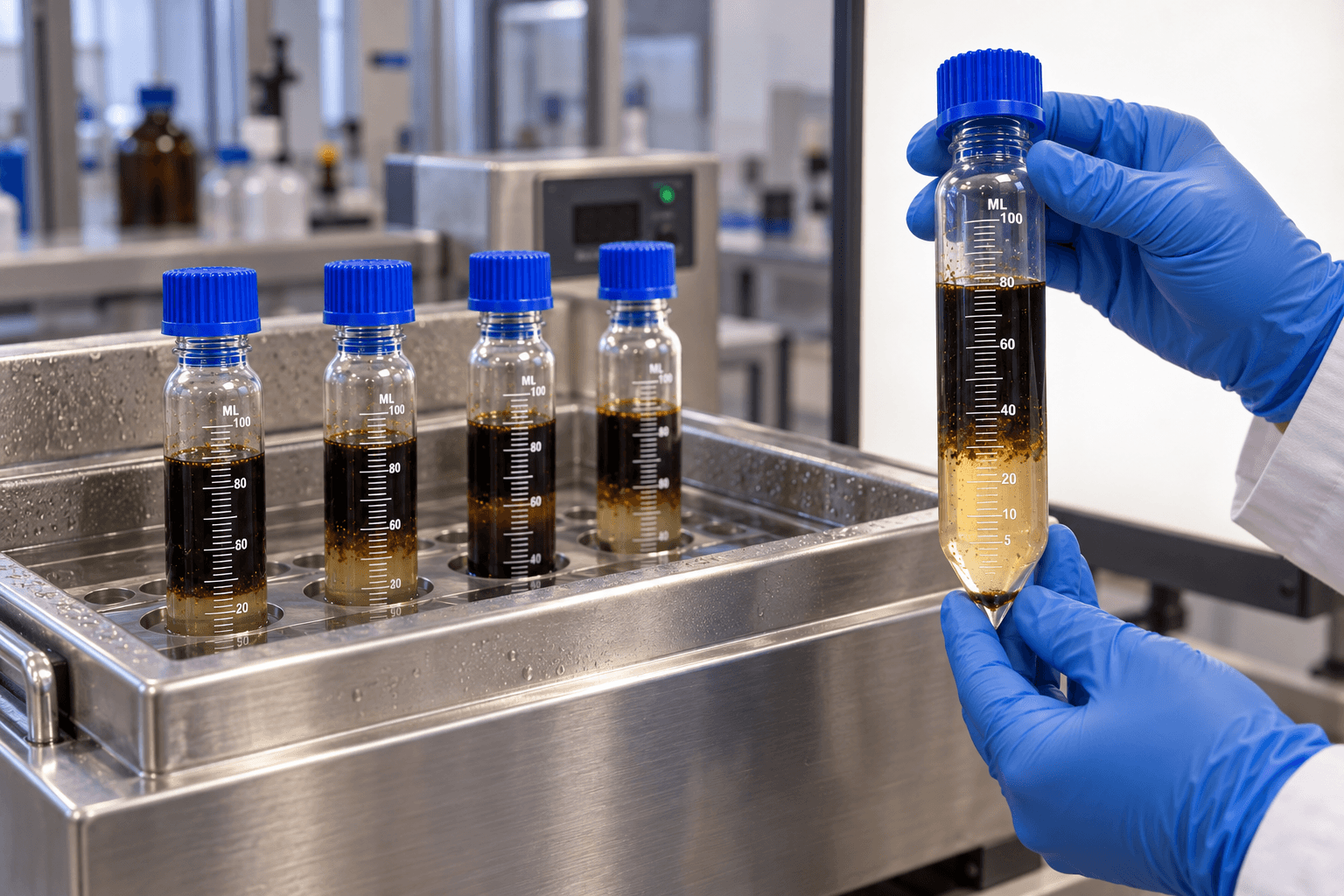
Demulsifier problems are rarely solved by changing the product on the basis of one bottle or one laboratory reading. Slow water separation, a persistent rag layer, dirty separated water and high residual BS&W can arise from chemistry, dosage, sample history, injection quality, process conditions or measurement error. A structured diagnosis should identify which part of the treatment system has changed before a new product is selected.
This guide presents a practical troubleshooting sequence for crude-oil dehydration and desalting service. It is intended to support technical screening and field investigation; it does not replace site-specific process review, safety procedures or a controlled field trial.
1. Define the failure precisely
“The demulsifier is not working” is not a diagnostic statement. Begin by identifying the measurable symptom, its location and the time at which it appears.
| Observed symptom | What it may indicate | First checks |
|---|---|---|
| Little or no early water drop | Slow chemical transport, strong interfacial film, low temperature, insufficient dose or poor mixing | Sample condition, temperature, dose basis, mixing and crude change |
| Fast water drop with a thick rag layer | Partial coalescence without complete interface collapse | Interface volume over time, final BS&W and dose response |
| Dark or oily separated water | Oil carry-under, over-treatment, phase-continuity change or unsuitable chemistry | OIW, water cut, dose, mixing severity and injection point |
| Clear water but high export BS&W | Water removed upstream but fine droplets remain, insufficient residence time or sampling mismatch | Sampling points, vessel residence, temperature and downstream performance |
| Performance deteriorates after a crude change | Different asphaltene/resin balance, wax, solids, salinity or blend compatibility | Crude blend, SARA-related indicators, water chemistry and fresh bottle testing |
| Product separates in storage | Solvent loss, incompatibility, low-temperature phase separation or poor homogenization | Product appearance, storage temperature, batch history and handling procedure |
2. Confirm that the comparison is valid
Before blaming chemistry, verify that the baseline and the problem period are comparable. Record crude throughput, water cut, temperature, pressure, separator levels, residence time, well lineup, wash-water conditions, other injected chemicals and equipment status. A demulsifier can appear weaker when the process load has increased or the effective residence time has fallen.
Laboratory comparisons require the same discipline. Use representative samples, identical bottle volumes, controlled temperature, a documented dose basis and consistent mixing. Sample ageing or uncontrolled re-homogenization can change the emulsion and reverse product rankings. For the full laboratory workflow, see How to Perform a Demulsifier Bottle Test.
3. Troubleshooting slow or absent water drop
A slow water drop can result from an interfacial film that remains resistant, but it can also be caused by transport and process limitations. Work through the following checks in sequence.
- Temperature: lower temperature increases crude viscosity, slows droplet movement and may change wax behavior. Compare at the actual treating temperature.
- Dose accuracy: verify the calibrated pump output or laboratory addition. State whether ppm refers to finished product, active material, volume/volume or mass/mass.
- Mixing: insufficient dispersion may prevent the chemical reaching droplets; excessive shear can create smaller droplets and fresh interface.
- Residence time: confirm that the chemical has reached the sampling point and that the observation period reflects the real process.
- Crude composition: changes in asphaltenes, resins, waxes, fine solids or blending can change the interfacial film.
- Water chemistry: salinity, divalent ions, pH and suspended solids can alter emulsion behavior and product response.
If the blank sample also stops separating, the problem may be a changed emulsion rather than a loss of chemical quality. Review the mechanisms in Crude Oil Types and Petroleum Emulsions before redesigning the screening range.
4. Troubleshooting a thick or persistent rag layer
A rag layer indicates that gross water separation has occurred but a concentrated emulsion remains at the interface. Do not evaluate it only at the first reading. Record rag volume, texture and whether it collapses, grows or remains stable with time.
Common contributors include a chemistry that promotes partial coalescence but does not sufficiently disrupt the native film, excessive or unsuitable mixing, high solids loading, interaction with corrosion inhibitors or other production chemicals, and a dose outside the useful operating window. A dose-response series is essential: both under-treatment and over-treatment can produce an unsatisfactory interface.
5. Troubleshooting dirty or oily separated water
A large water drop is not automatically a successful result. Dark, hazy or oily separated water may indicate oil carry-under, very fine oil droplets in the water phase, or a change in phase continuity. Visual appearance should be supported by a validated oil-in-water measurement whenever water quality is a process or discharge KPI.
Check whether the candidate is too hydrophilic for the system, whether dosage is excessive, and whether the mixing or injection location is transferring oil into the water phase. Also check for phase inversion at high water cut. A product that improves oil dehydration while damaging produced-water quality is not a complete technical solution.
6. Troubleshooting high final BS&W despite visible separation
Visible free water at the bottom of a bottle or vessel does not prove that the treated oil meets specification. Fine droplets can remain suspended, particularly when viscosity is high or residence time is short. Verify final water or BS&W using the same validated analytical method for the baseline and candidate.
Check the sampling location and timing. A sample collected before the new chemistry has displaced the previous product, or before the process has stabilized, can produce a misleading result. In multi-vessel systems, determine whether water removal has shifted upstream or downstream rather than relying only on the final outlet. The structured approach is described in How to Conduct a Demulsifier Field Trial.
7. Check for underdose, overdose and a narrow operating window
Demulsifier response is not always linear. Increasing dosage can improve performance, reach a plateau or worsen interface and water quality. Test a range that brackets the current field dose and include the incumbent product and an untreated blank.
When converting pump rate to field dosage, use actual measured chemical delivery and the defined crude-flow basis. The Demulsifier Dosage Calculator converts crude flow and chemical rate to volumetric ppm and can also calculate the required L/day for a target dosage.
8. Inspect the chemical before changing the formulation
Check the product for phase separation, sediment, precipitation, unexpected viscosity, colour change or solvent loss. Confirm the batch, storage temperature and container condition. If the product is a multicomponent blend, low-temperature storage or solvent imbalance can change homogeneity and delivered composition.
Do not apply uncontrolled heating or aggressive mixing without a suitable handling procedure. First determine whether the observed separation is reversible and whether a representative sample can be obtained. Product-integrity problems should be investigated separately from crude-response problems.
9. Use a disciplined diagnostic sequence
- Define the failed KPI and sampling point.
- Confirm the analytical method and repeat the measurement.
- Review crude, water and process changes.
- Verify actual dose, dose basis and chemical delivery.
- Inspect product condition and batch history.
- Run a controlled blank, incumbent and candidate bottle-test series.
- Assess water drop, interface, water quality and final oil quality together.
- Repeat the most important comparison to check reproducibility.
- Only then decide whether the issue requires dosage optimization, application correction or formulation change.
10. Minimum data for a technical review
- Crude source or blend and recent changes
- API gravity, viscosity and relevant compositional information where available
- Water cut, salinity and produced-water observations
- Treating temperature, pressure and residence time
- Current product, dosage basis and verified injection rate
- Bottle-test protocol and timed results
- Interface/rag observations and separated-water quality
- Final oil BS&W or water content
- Process configuration, injection point and sampling locations
- Recent operating or chemical-program changes
When is reformulation justified?
Reformulation is justified when the problem remains reproducible after sample handling, dose accuracy, temperature, mixing, residence time and product integrity have been checked. The objective should be specific: faster early water removal, a sharper interface, lower final BS&W, cleaner water, improved salt removal or broader robustness to crude variation.
Commercial demulsifiers are commonly blends because one component may improve transport while another targets interface displacement or coalescence. A useful review therefore considers molecular architecture and blend balance rather than relying on a single hydrophilic-lipophilic descriptor. See Demulsifier Base Chemistries for a deeper technical discussion.
Frequently asked questions
Does faster water drop always mean a better demulsifier?
No. Early water drop must be assessed together with final oil quality, interface/rag, separated-water quality, dose response and repeatability.
Can too much demulsifier worsen performance?
Yes. Some systems show a limited useful dosage window, and excessive treatment can worsen interface quality or oil-in-water performance. Confirm with a controlled dose-response series.
Why can a laboratory winner fail in the field?
The laboratory may not reproduce field shear, residence-time distribution, crude blending, chemical carryover, injection quality or process variability. Bottle testing shortlists candidates; a controlled field trial qualifies them.
What should be checked first when performance suddenly falls?
Confirm the measurement, crude and water-cut changes, temperature, actual chemical delivery, injection point, product condition and process residence time before changing formulation.
Technical review: Horizons Apex supports structured demulsifier troubleshooting, bottle-test design, formulation review and field-trial planning. To begin a focused review, share the operating conditions, current dosage, sample history and the specific KPI that has deteriorated through our technical contact form.