
How to Perform a Demulsifier Bottle Test: A Practical Oilfield Evaluation Method
Demulsification · Laboratory Method
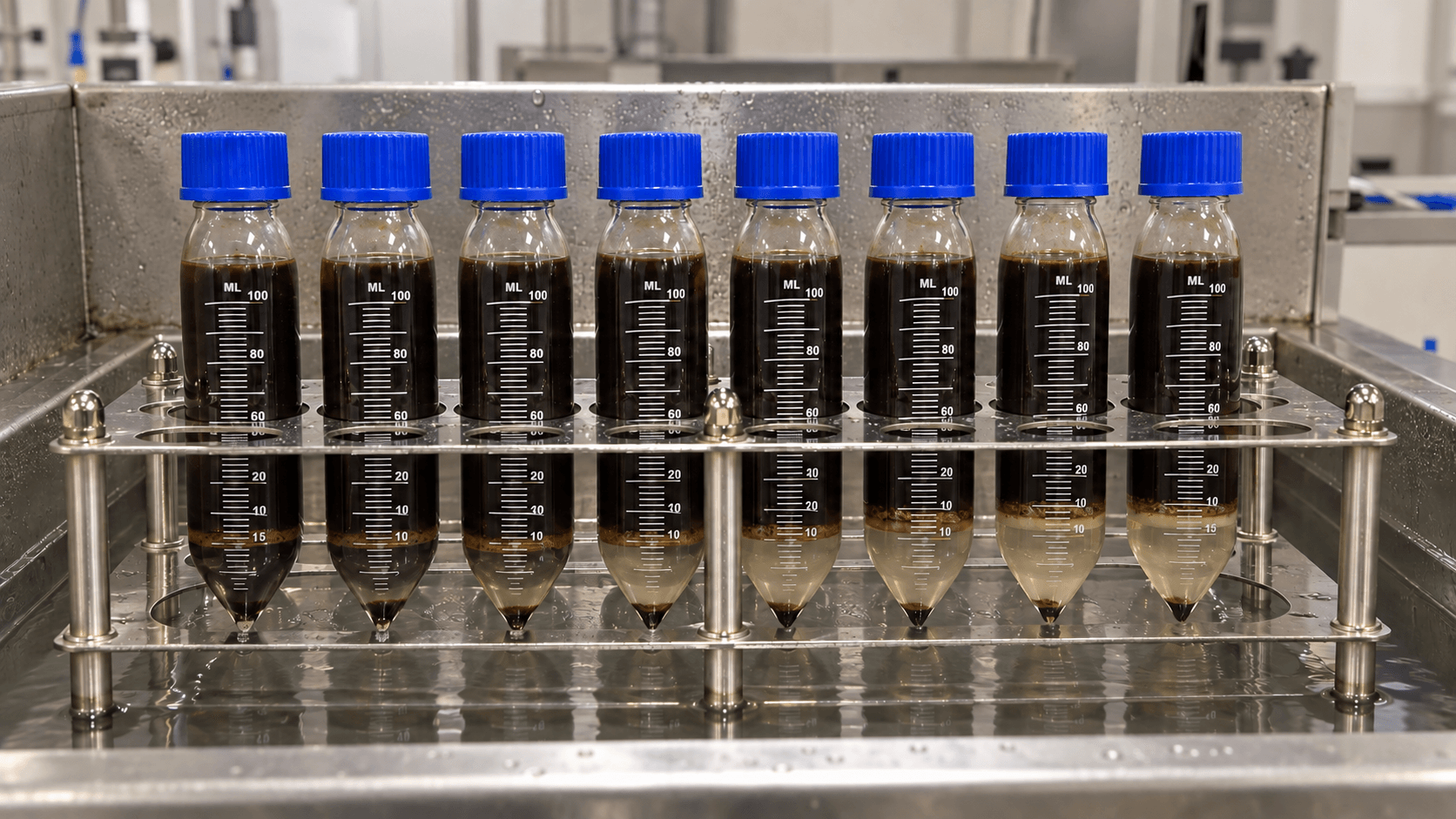
The demulsifier bottle test is a comparative screening method, not a universal one-size-fits-all standard. Its value comes from controlling the variables that can change emulsion breaking: sample history, temperature, dosage, mixing energy, settling time and the criteria used to judge separation. A useful test should reproduce the field decision closely enough to shortlist candidates for a controlled field trial.
1. Define the purpose before starting
A bottle test may be used to compare products, optimize dosage, investigate changing crude conditions or evaluate a formulation change. The protocol should be fixed before testing so that chemistry—not inconsistent handling—drives the ranking.
2. Collect a representative crude-oil emulsion
Whenever possible, use a fresh process emulsion sampled upstream of demulsifier injection or before significant separation has occurred. Record the field, sample point, sampling time, temperature, water cut/BS&W, current treatment and relevant operating conditions.
Emulsion ageing can change interfacial-film strength and separation behavior. Sample history should therefore be controlled and reported. If the bulk sample must be redistributed into test bottles, re-homogenize it reproducibly without applying uncontrolled high shear.
3. Determine initial water content
The initial emulsified-water content provides the reference against which separated-water volume can be interpreted. Depending on the laboratory and crude, an appropriate standardized water/BS&W method should be used. ASTM D4007 covers water and sediment in crude oil by centrifuge, but the method itself notes that the observed water result is almost always lower than the actual water content; for high-accuracy water determination, ASTM D4006 (distillation) or another validated method may be more appropriate.
If the original emulsified-water volume is known, a simple water-removal efficiency can be expressed as:
Water removal (%) = Vseparated,t / Vinitial water × 100
This metric is useful but should not replace evaluation of interface, water quality and residual water in the oil.
4. Prepare identical test bottles
Use clean, identically graduated, closable glass bottles or centrifuge tubes. Published bottle-test studies commonly use 50 or 100 mL samples; 100 mL is particularly convenient because separated-water volume can be read directly and compared across candidates.
All bottles in one comparison should contain the same sample volume and should experience the same temperature and handling history.
5. Include controls and references
- Blank: emulsion with no added demulsifier.
- Incumbent/reference: the current field product at its relevant dosage, where available.
- Candidates: each new product at one or more predefined dosages.
- Replicates: duplicates or repeat runs when repeatability matters.
A candidate should not be judged only against another new product. The untreated blank shows natural separation, while the incumbent provides a practical performance benchmark.
6. Control the test temperature
Temperature changes crude viscosity, droplet mobility, wax behavior, interfacial properties and coalescence kinetics. The preferred screening temperature should therefore represent the actual treating condition unless the experiment is intentionally studying temperature sensitivity.
Published studies use many different temperatures—50 °C, 60 °C and other values—but these are experimental conditions, not universal bottle-test standards. The relevant field temperature is the defensible starting point.
7. Equilibrate the sample before dosing
Bring all test bottles to the selected temperature using a thermostatically controlled bath or other validated method. Temperature should be stable and consistent across the series before performance is compared.
8. Prepare and define the demulsifier dose correctly
The report must state what “ppm” means. It may refer to finished commercial product, neat active or a prepared stock solution. These are not interchangeable.
For a liquid product dosed on a mass basis:
Dose (ppmw) = mass of product / mass of emulsion × 106
If a diluted stock solution is used, the stock concentration and active basis must be documented. Published studies frequently prepare defined active solutions—for example 10% active in a solvent—and then dose those stocks. Other field-oriented methods dose the commercial product directly. Both approaches can be valid if the basis is explicit and consistent.
For very small additions, gravimetric dosing can improve accuracy and avoid errors caused by density, viscosity and temperature when tiny liquid volumes are measured.
For field-rate conversion between crude flow, chemical L/day and volumetric ppm, use the Demulsifier Dosage Calculator.
9. Use a dose-response series
A single concentration cannot identify an optimum. Select a dosage range that brackets the incumbent or expected field range. Published research has used ranges such as 10–50 ppm, 10–60 ppm and 25–200 ppm depending on crude and study objective; these are examples, not universal recommendations.
The objective is to determine whether performance improves, plateaus or deteriorates with increasing dosage.
10. Standardize mixing energy
After dosing, every bottle must receive the same mixing treatment. Literature methods range from controlled hand inversion to vigorous shaking or mechanical mixing for a defined time. Because mixing changes chemical distribution and droplet collisions, different protocols can change product ranking.
Do not combine data from bottles that received visibly different mixing energy. Record the method, duration, equipment and any coalescence-shake sequence used.
11. Start the settling clock consistently
Return all bottles to the controlled-temperature environment immediately after mixing and define time zero consistently. Keep the bottles undisturbed except where the protocol intentionally specifies additional mixing.
12. Record water drop versus time
Read separated water directly from the graduations at predefined intervals appropriate to the process. Published studies use schedules ranging from sub-minute observations to several hours. A practical field-oriented schedule might include early and later readings such as 5, 10, 20, 30, 60 and 120 minutes, but the actual schedule should reflect separator residence time and the objective of the test.
Plotting separated-water volume against time is more informative than recording only a final value because two products can reach the same final water volume with very different kinetics.
13. Evaluate the oil–water interface
Water drop alone is not enough. Record whether the interface is sharp and compact or contains a thick rag/emulsion layer. A fast water drop accompanied by a persistent rag layer can be operationally inferior to a slightly slower but cleaner separation.
A simple laboratory scoring system may be used, but the scale and definitions should be documented before ranking products.
14. Evaluate separated-water quality
Observe whether the separated water is clear, hazy or visibly oil-contaminated. Where discharge or reinjection quality matters, visual inspection can be supplemented by an appropriate oil-in-water measurement.
A demulsifier that transfers excessive oil into the water phase should not be ranked as a winner solely because it produces a large apparent water drop.
15. Measure residual water or BS&W in the treated oil
Final oil quality is a critical endpoint. Published demulsifier studies use centrifuge-based S&W/BS&W as well as distillation-type water determination. The analytical method should be appropriate for the crude and specification, and the same method should be used consistently across candidates. Where accurate water content is critical, the known limitations of ASTM D4007 should be considered.
This step distinguishes true dehydration from simple visible water separation.
16. Use a multidimensional ranking
| Criterion | What it tells you | Desired behavior |
|---|---|---|
| Water drop vs time | Separation kinetics | Appropriate speed and high recovery |
| Final separated water | Extent of gross separation | Consistent with initial water content |
| Interface/rag | Residual emulsion stability | Thin, sharp, collapsing interface |
| Water quality | Oil carryover into water | Clean water for the process requirement |
| Final oil BS&W | Actual dehydration quality | Meets the target specification |
| Dose response | Efficiency and overdose behavior | Robust performance over practical range |
| Repeatability | Confidence in ranking | Similar behavior in repeat runs |
17. Do not select a winner from the 10-minute water drop alone
An early water-drop reading can be useful when rapid separation is operationally important, but it is only one endpoint. A product can show excellent early water drop yet leave a dirty interface, high residual BS&W or poor separated-water quality.
The ranking should reflect the field requirement: dehydration, desalting support, water quality, residence time and stability of the separation.
18. Check repeatability
Bottle testing is sensitive to sample heterogeneity and operator technique. Duplicate tests or independent repeat runs provide evidence that an apparent winner is real. Published field-oriented research has explicitly used repeat testing and confidence criteria to validate water-separation curves.
If duplicates disagree substantially, investigate sample homogenization, dosing accuracy, temperature and mixing before drawing a formulation conclusion.
19. Be cautious with artificially prepared emulsions
Synthetic laboratory emulsions are valuable for controlled mechanistic studies, but their droplet-size distribution and interfacial history can differ from produced field emulsions. High-shear preparation methods can create emulsions much more severe than the process sample.
For field product selection, fresh representative field emulsion is preferable when available.
20. Heavy and highly viscous crude may require an adapted method
For very viscous crude, gravitational bottle separation can be too slow to discriminate candidates within a practical laboratory period. Published research has adapted the method using controlled centrifugation while maintaining defined temperature and emulsion preparation.
Such an adapted method should be reported as an adapted protocol rather than presented as directly equivalent to a conventional gravity bottle test.
21. Suggested bottle-test data sheet
For routine work, keep the time-series table narrow enough to remain readable on mobile and record final quality criteria separately.
| Bottle | Product | Dose (ppm, basis stated) | 5 min water (mL) | 10 min | 20 min | 30 min | 60 min | 120 min |
|---|---|---|---|---|---|---|---|---|
| Blank | None | 0 | — | — | — | — | — | — |
| Reference | Incumbent | Defined | — | — | — | — | — | — |
| A-L | Candidate A | Low | — | — | — | — | — | — |
| A-M | Candidate A | Mid | — | — | — | — | — | — |
| A-H | Candidate A | High | — | — | — | — | — | — |
Final-quality record for each bottle: interface/rag description; separated-water appearance or measured oil-in-water where required; final oil BS&W/water by the selected analytical method; and remarks such as wall wetting, sludge, unusual color or re-emulsification.
The sheet header should also record sample source and point, sampling date/time, initial water content and method, test temperature, sample volume, demulsifier/stock identity and concentration, dosage basis, mixing protocol, observation schedule and operator. If the crude contains 10 mL initial water in a 100 mL test sample, for example, 8 mL separated water corresponds to 80% gross water removal; the denominator must be the measured initial water, not the bottle volume.
22. From bottle test to field trial
The bottle test is a screening and optimization tool. It does not reproduce separator geometry, continuous chemical injection, full-scale mixing, electrostatic coalescence, changing production or long residence-time distributions.
Shortlist the candidates that meet the full laboratory performance target, then verify them in a controlled field trial with defined baseline, dosage steps and monitoring. Laboratory ranking is evidence for field selection—not a substitute for field validation.
Frequently asked questions
Is there one universal bottle-test temperature?
No. Published studies use different temperatures. For field selection, the actual treating temperature is usually the most relevant starting point unless temperature sensitivity is being studied deliberately.
How many shakes should be used?
There is no single universal number across published bottle-test methods. Use a fixed, documented and reproducible mixing protocol appropriate to the process and apply it identically to every bottle.
Should demulsifier dosage be reported on active or finished-product basis?
Either can be used if explicitly defined. Comparisons become misleading when one sample is reported as finished-product ppm and another as active ppm without correction.
Is the product with the fastest water drop the best?
Not necessarily. Interface quality, separated-water quality, residual oil BS&W, dose response and repeatability should also be considered.
Conclusion
A defensible demulsifier bottle test depends more on experimental discipline than on one prescribed number of shakes, one temperature or one dosage range. Representative sample handling, controlled temperature, accurate dosing, identical mixing, timed water-drop curves, interface assessment, water quality and final oil BS&W together provide a much stronger basis for selection than water drop alone.
The final objective is not to create a laboratory winner. It is to identify a robust candidate and dosage window that can be validated safely under actual separation conditions.
Technical references
- Pradilla, D. et al. Demulsifier Selection from Laboratory Bottle-Testing to Field Evaluation. Journal of Petroleum Science and Engineering 2018, 163, 202–211. DOI: 10.1016/j.petrol.2017.12.086.
- Al-Sabagh, A. M. et al. Preparation and evaluation of demulsifiers agents for Basra crude oil. Applied Petrochemical Research 2011. DOI: 10.1007/s13203-011-0003-1.
- The Influence of Newly Synthesized Demulsifiers on the Interfacial Rheological Properties of a Naturally Occurring Water/Oil Emulsion. ACS Omega 2022. DOI: 10.1021/acsomega.2c03958.
- SY/T 5281-2000, Bottle Test Method for the Demulsification Performance of Crude Oil Demulsifiers.
- ASTM D4007, Standard Test Method for Water and Sediment in Crude Oil by the Centrifuge Method.
- ASTM D4006, Standard Test Method for Water in Crude Oil by Distillation.
Related Horizons Apex resources: Demulsifiers, Common Bottle-Test Errors, Selecting a Demulsifier for Changing Crude Conditions, and Demulsifier Base Chemistries.