
How to Conduct a Demulsifier Field Trial: A Practical Method for Performance Evaluation
Demulsification · Field Evaluation
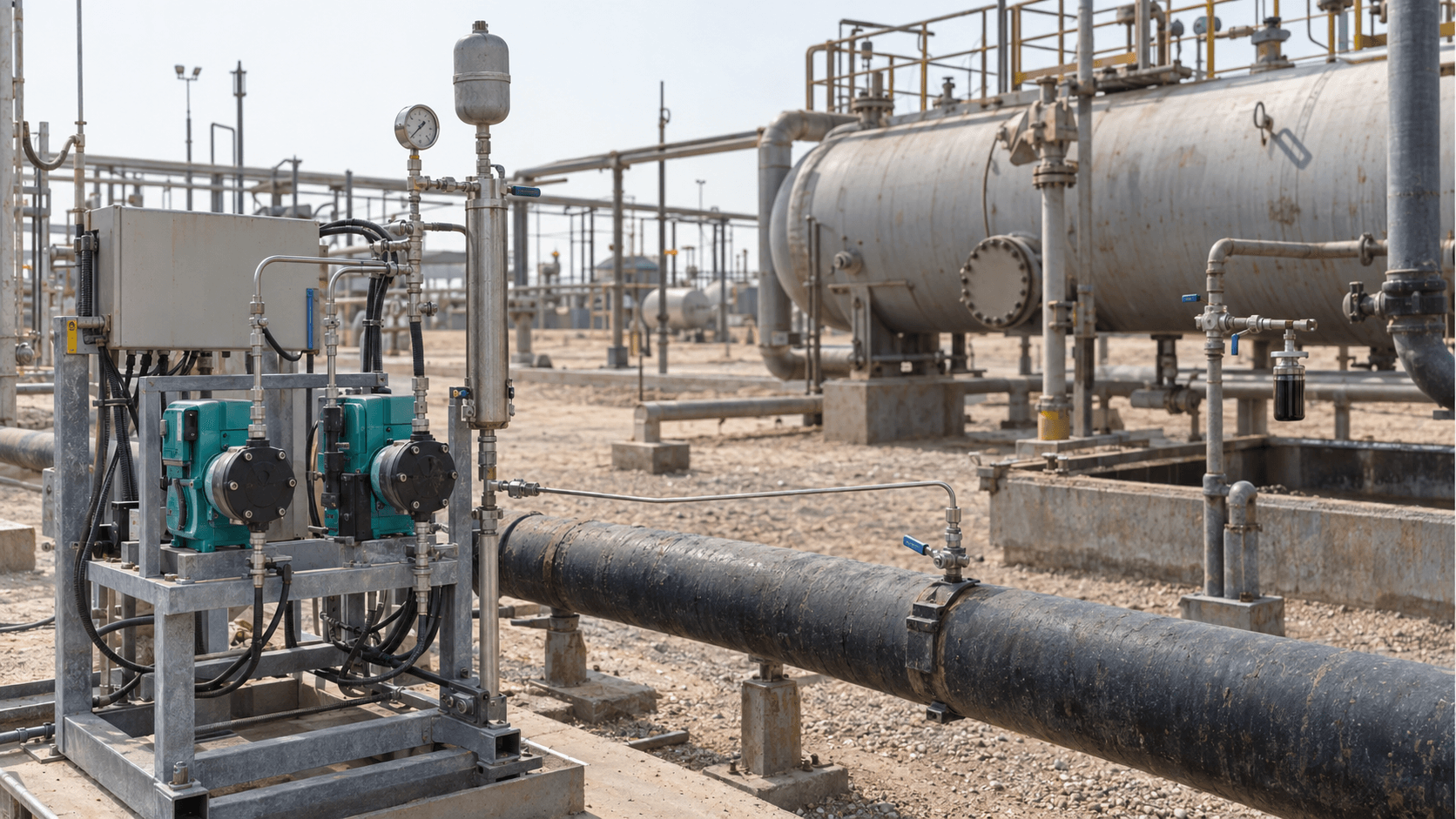
A demulsifier field trial is not simply “change the chemical and watch BS&W.” A defensible trial must separate chemical performance from changes in crude, water cut, temperature, throughput, residence time, equipment operation and measurement error. The objective is to determine whether a candidate can meet the facility’s oil, water and interface requirements over a practical dosage window without creating a new operating problem.
1. Start with a written trial objective
Define the specific process target before changing chemical. Examples include increasing early water removal before a dehydrator, lowering export BS&W, improving desalter salt removal, reducing rag, improving produced-water quality or reducing chemical consumption while maintaining specifications.
The KPI set must match that objective. A trial designed to improve first-stage water draw-off should not be judged only by final export BS&W.
2. Map the treatment and sampling system
Before the trial, document the chemical injection point, production headers, separators, heater-treaters, dehydrators/desalters, water draw-off points, oil sampling points and produced-water sampling points. Identify where each KPI is measured and what residence time lies between injection and measurement.
This process map prevents a common error: attributing a sample to the new demulsifier before the candidate has actually reached and displaced the previous chemistry at that location.
3. Establish a reliable incumbent baseline
Collect baseline data under the incumbent product before introducing the candidate. The baseline should represent reasonably stable operation and capture normal variability rather than one favorable snapshot.
- Actual demulsifier injection rate and calculated dosage
- Wet-crude and/or oil flow rate
- Water cut and water draw-off by vessel where available
- Temperatures and relevant pressures
- Separator/dehydrator/desalter interface and liquid levels
- Oil BS&W/water content at defined sampling points
- Salt in crude where desalting is relevant
- Produced-water oil-in-water (OIW) or validated water-quality metric
- Rag/interface condition
- Electrical voltage/current/load behavior for electrostatic equipment
- Wash-water rate and mixer conditions for desalters
4. Verify the actual dosage, not only the pump set point
Field dosage errors can invalidate a comparison. Verify chemical pump calibration and, where possible, reconcile actual chemical consumption against tank level/weight or another independent measure. Confirm the wet-crude flow measurement used to calculate ppm.
On a mass basis:
Demulsifier dose (ppmw) = demulsifier mass flow / wet-crude mass flow × 106
On a volume basis, the calculation must explicitly use product and crude density if converting to a mass-based ppm. Report whether dosage is finished-product ppm or active-equivalent ppm. For the laboratory basis behind candidate selection and ppm definition, see How to Perform a Demulsifier Bottle Test.
For quick verification of volumetric field dosage or required injection rate, use the Demulsifier Dosage Calculator.
5. Check candidate product integrity
Before field injection, inspect the candidate for phase separation, sediment, precipitation, unexpected viscosity or solvent loss. Homogenize only according to an appropriate product-handling procedure. A non-homogeneous chemical can produce an apparent dosage-performance problem that is actually a storage/sample-quality problem.
6. Control confounding variables
Try to keep major process variables as stable as practical during comparative periods. Crude and emulsion behavior can change materially with composition, water chemistry, solids, shear and ageing; see Crude Oil Types and Petroleum Emulsions for the underlying mechanisms. At minimum, record changes in:
- Well lineup and crude blend
- Oil and water production rates
- Water cut
- Temperature
- Pressure and separator operating levels
- Wash-water rate and quality
- Desalter mixer/valve pressure drop
- Other production-chemical rates
- Equipment configuration or maintenance condition
If a major variable changes, do not hide it by averaging the data into the trial result. Mark the affected interval and decide whether it remains comparable.
7. Understand residence-time distribution and chemical carryover
A production vessel does not normally behave like an ideal plug-flow pipe. It can contain short-circuiting paths and long residence-time tails. After a dosage change, residual demulsifier from the previous condition can remain in the process and influence downstream performance.
Published Saudi Aramco field work demonstrated a significant accumulation effect when demulsifier dosage was decreased: water draw-off responded slowly because residual chemical remained in the separation system. The authors found that increasing dosage stepwise produced more interpretable optimization data than decreasing from high dosage.
8. Do not assume one fixed stabilization time
The correct hold time after a chemical or dosage change depends on injection-to-sampling travel time, vessel residence-time distribution, recirculation, tank inventory and process dynamics. One hour, one shift or one day cannot be prescribed universally.
Use process response to identify a stable evaluation window. In the published Aramco study, dosage steps were held on the order of a day, and the authors noted that some declining-dose responses could require two or more days to fully stabilize because of accumulation. That is evidence from one facility, not a universal rule.
9. Introduce the candidate conservatively
The initial candidate dose should be selected from laboratory screening, incumbent experience and process risk. A temporary backup strategy may be appropriate in critical service, but any simultaneous incumbent injection must be documented because it changes interpretation.
Do not make large uncontrolled changes in chemical rate while also changing temperature, interface level or wash water.
10. Optimize dosage with controlled steps
Once the candidate is established, evaluate multiple dosage levels. Stepwise increases are often easier to interpret than starting high and stepping downward because residual accumulated chemical can make a lower dose appear stronger than it really is.
The step size should reflect the facility and expected dose-response; a fixed 10-ppm step is not universal. The objective is to identify the practical performance plateau and the minimum robust dose that meets the defined KPIs.
11. Measure water separation by vessel where possible
When flowmeters are reliable, water draw-off from individual separation vessels provides valuable information about where the candidate is acting. A demulsifier may not change final dehydration dramatically but may shift water removal upstream, reducing downstream load.
A useful fraction for a vessel can be expressed relative to total measured separated water, provided the relevant flows are measured consistently and the water balance is credible.
12. Close mass balances
Process data should be checked for physical consistency. Compare incoming wet-crude/water estimates with measured oil and water outlets where instrumentation allows. Large unexplained imbalances can indicate meter error, changing inventory or unsuitable averaging windows.
Field-trial literature specifically emphasizes checking process data and mass balances and correcting errors in demulsifier dosage, flow rate and temperature before interpreting product performance.
13. Oil-side KPIs
Oil quality should be evaluated at the points relevant to the facility:
- BS&W or water content
- Salt content for desalting service
- Stability of specification over time
- Water content entering downstream dehydrators/desalters
- Any evidence of persistent rag or entrainment
Use the same validated analytical method and sampling procedure for baseline and candidate periods.
14. Water-side KPIs
A demulsifier can improve oil dehydration while worsening produced-water quality. Monitor OIW or the facility’s validated water-quality metric at appropriate stages. Visual clarity alone is useful operational information but should not replace quantitative OIW when a numerical specification exists.
15. Interface and rag KPIs
Record interface level, rag thickness/appearance, sludge accumulation and level-control stability. A candidate that gives low BS&W but builds a growing rag layer can create delayed operational problems that a short trial misses.
16. Electrostatic-unit KPIs
For electrostatic dehydrators/desalters, monitor electrical behavior together with separation quality. Relevant signals may include voltage, current/load, trips, arcing/short-circuit events or other equipment-specific stability indicators. The significance of these KPIs depends on the separation hardware; see Crude Oil Dehydration and Desalting Systems for the differences between gravity, coalescer, heater-treater and electrostatic facilities.
Do not attribute every electrical event to chemistry; water level, conductivity, solids, electrodes, power equipment and control faults must also be considered.
17. Desalter-specific KPIs
For crude desalting, evaluate salt removal together with outlet BS&W, wash-water rate/quality, mixing conditions, effluent-water quality, interface/rag and electrical stability. A candidate should not be declared superior from dehydration alone if salt removal deteriorates.
18. Build a structured field-trial sheet
| KPI | Incumbent baseline | Candidate dose 1 | Dose 2 | Dose 3 | Validation |
|---|---|---|---|---|---|
| Actual dose | |||||
| Throughput | |||||
| Water cut | |||||
| Temperature | |||||
| Water draw-off | |||||
| Final BS&W | |||||
| Salt | |||||
| OIW | |||||
| Rag/interface | |||||
| Electrical behavior |
19. Compare stable windows, not isolated samples
Single grab samples are vulnerable to sampling and process variability. Define stable windows after each change and compare distributions or averages together with variability. Retain the raw time series so transient upsets are not hidden.
20. Use repeat/confirmation periods
If the candidate appears better at an optimized dose, confirm the result under another comparable operating period. Where operationally safe and justified, an A–B–A or incumbent/candidate/incumbent comparison can help distinguish a chemical effect from a coincident process trend.
Such crossover testing is not always practical in continuous production, so the decision must consider process risk and chemical carryover.
21. Define stop and recovery criteria before the trial
Agree in advance what constitutes an unacceptable upset: for example export BS&W outside specification, excessive rag, produced-water deterioration, unstable electrostatic operation or another facility-specific limit. Define who has authority to stop the trial and how the incumbent or recovery dose will be restored.
22. Evaluate economics only after technical qualification
Calculate chemical cost on a consistent treated-volume basis:
Chemical cost per treated barrel = chemical consumption × delivered chemical price / treated crude volume
But do not optimize cost by ppm alone. A lower-dose product that increases downstream water load, salt, OIW, rag or operating instability may be more expensive overall.
23. Common field-trial mistakes
- Changing candidate, dose and operating conditions simultaneously
- Using pump set point instead of verified chemical consumption
- Sampling before the candidate reaches the measurement point
- Stepping rapidly from high to low dose and ignoring residual accumulation
- Judging only export BS&W
- Ignoring produced-water quality
- Ignoring vessel-by-vessel water removal
- Comparing data from materially different crude blends or water cuts without qualification
- Using one grab sample as proof of superiority
24. Recommended trial sequence
- Laboratory shortlist: select credible candidates with representative bottle testing.
- Process mapping: establish injection, residence and sampling relationships.
- Baseline: characterize incumbent performance and variability.
- Candidate introduction: introduce at a justified conservative dose.
- Stabilization: wait for a defensible process-response window.
- Dose optimization: use controlled steps while monitoring all KPIs.
- Confirmation: repeat the preferred condition under comparable operation.
- Technical review: check oil, water, interface and equipment behavior.
- Economic review: compare total chemical and operational value.
- Final decision: define the operating dosage window and monitoring plan.
25. What a successful field trial should prove
A successful trial should demonstrate not merely that the candidate can produce a good sample, but that it can maintain the required separation under representative operating variability at a practical dosage. The result should be supported by reconciled process data and by oil-side, water-side and equipment KPIs.
Frequently asked questions
Should a field trial start at the incumbent ppm?
Not automatically. The starting dose should reflect laboratory performance, product concentration/basis and process risk. If products have different active concentrations or formulation architectures, equal finished-product ppm may not represent an equivalent chemical challenge.
How long should each dosage step be held?
There is no universal duration. Hold long enough for chemical travel, vessel residence-time distribution and the monitored KPIs to reach a defensible stable response. Published field work has used daily steps, but facility dynamics can require shorter or longer periods.
Should dosage be increased or decreased during optimization?
Stepwise increases can reduce the risk of falsely attributing residual accumulated chemical to a lower dosage. Published Saudi Aramco work specifically observed this carryover effect when stepping downward.
Is lower BS&W enough to select a winner?
No. Water draw-off, salt where relevant, produced-water OIW, interface/rag, process stability, electrical behavior and economics should also be considered.
Conclusion
Demulsifier field evaluation is a controlled process experiment. The quality of the conclusion depends as much on baseline definition, flow measurement, residence-time understanding, dosage verification and process stability as on the chemistry itself.
The most reliable approach connects laboratory screening to a structured field protocol: establish the incumbent baseline, introduce the candidate carefully, allow the process to respond, optimize dose in controlled steps, close mass balances, monitor oil and water quality together, confirm the preferred condition and only then compare economics.
Technical references
- Raynel, G.; Marques, D. S.; Al-Khabaz, S.; Al-Thabet, M.; Oshinowo, L. A new method to select demulsifiers and optimize dosage at wet crude oil separation facilities. Oil & Gas Science and Technology – Rev. IFP Energies nouvelles 2021, 76, 19. DOI: 10.2516/ogst/2020096.
- Kokal, S. L. Crude-Oil Emulsions: A State-of-the-Art Review. SPE Production & Facilities 2005, 20, 5–13. DOI: 10.2118/77497-PA.
Related Horizons Apex resources: Demulsifier Bottle Test Method, Crude Oil Dehydration and Desalting Systems, Crude Oil Types and Petroleum Emulsions, and Demulsifier Base Chemistries.