
Demulsifier Base Chemistries: How They Are Made and How They Work
Demulsification · Chemistry Review
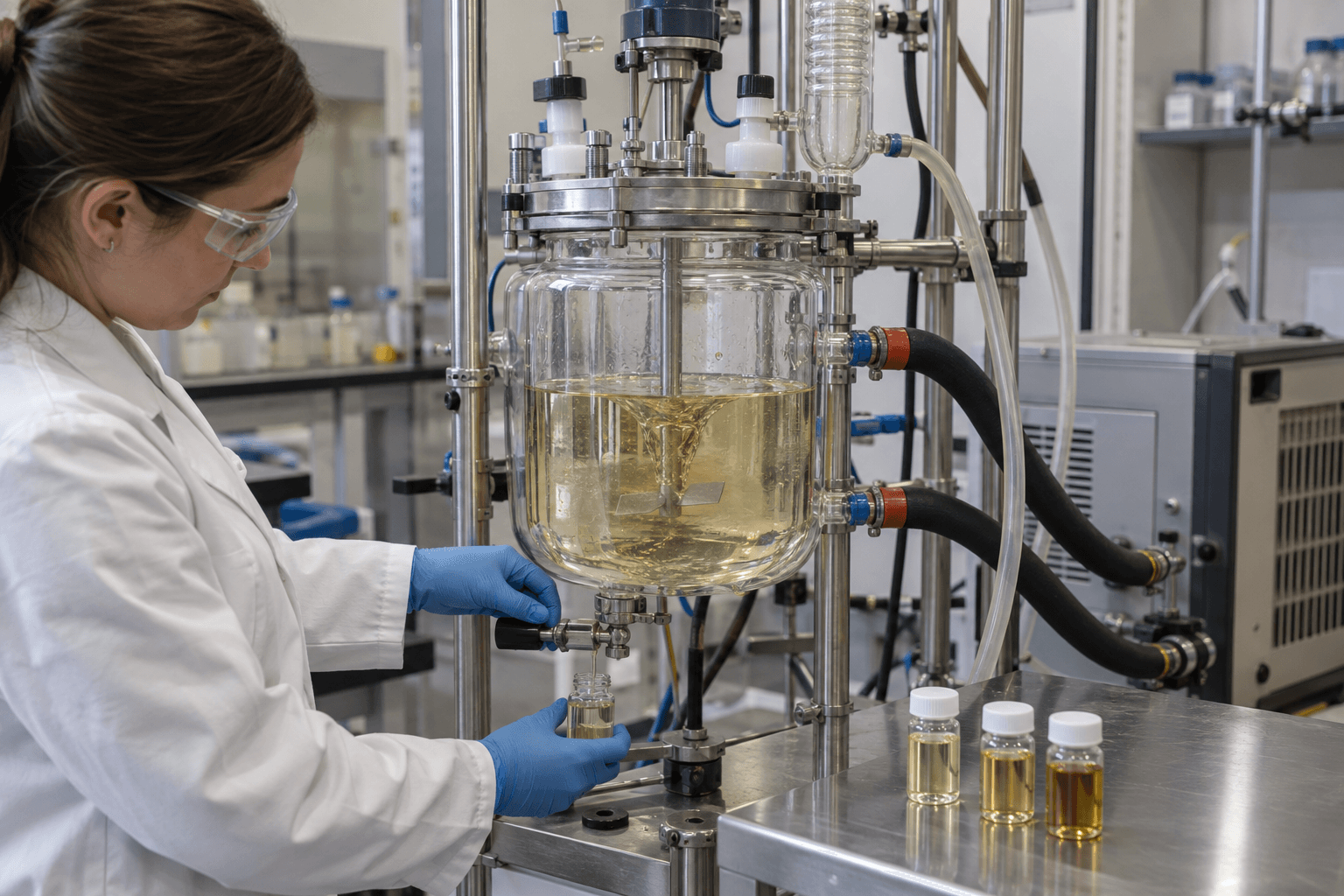
Crude-oil demulsifiers are not a single chemistry. Commercial formulations can be multicomponent systems containing more than one surface-active base chemistry. The active molecules must be delivered into the crude, reach the water–oil interface on a useful timescale, and destabilize the native interfacial film sufficiently to promote droplet coalescence and phase separation. Performance depends not only on hydrophilic–lipophilic character, but also on molecular architecture, functionality, EO/PO distribution, molecular size, crude composition, temperature, water cut, salinity, concentration and process conditions.
This article reviews the major demulsifier base chemistries used or reported for water-in-crude-oil emulsions, how those chemical families are built at a reaction-pathway level, and what is known about how they act at the interface. It deliberately avoids treating any one mechanism or chemical family as universal.
1. Why crude-oil emulsions can be difficult to break
Produced crude commonly contains naturally occurring surface-active species, especially asphaltenes and resins, that can adsorb at the water–oil interface and form mechanically resistant interfacial films. Fine solids and other polar components can further reinforce these films. A demulsifier must therefore do more than simply lower interfacial tension: it must reach the interface on the relevant timescale and alter the interfacial structure sufficiently to allow water droplets to approach, drain the intervening oil film, and coalesce.
Research on heavy crude oils has shown that rapid interfacial adsorption or a large reduction in equilibrium interfacial tension is not, by itself, a guarantee of good dehydration. Molecular configuration, steric effects, crude composition, and the nature of the native interfacial film can dominate performance.
2. EO/PO polyethers: one of the central demulsifier platforms
How they are built
Polyether demulsifiers are produced by ring-opening alkoxylation of a molecule containing reactive hydrogen functionality. Depending on the desired architecture, the starter can be a glycol, glycerol, another polyol, an amine, or a multifunctional resin. Propylene oxide (PO) and ethylene oxide (EO) are then incorporated sequentially or in designed distributions to create polyoxypropylene and polyoxyethylene segments.
Changing the starter functionality, PO/EO ratio, sequence, block length and overall molecular size changes the resulting polymer’s architecture and phase affinity. A PO-rich segment is generally more oil-compatible, while increasing EO content generally increases hydrophilicity; however, field performance cannot be predicted from EO/PO ratio alone.
How they can work
EO/PO polyethers can migrate to the water–oil interface and interact with the native interfacial layer. Experimental and molecular-simulation studies support mechanisms that include competitive displacement or reorganization of asphaltenic interfacial material, weakening of the stabilizing film, and promotion of droplet coalescence. Recent molecular-dynamics work also suggests concentration-dependent behavior for a model EO/PO polyether, reinforcing the point that “the mechanism” can change with formulation and concentration.
Importantly, PEO/PPO block copolymers that perform well in lighter crudes may perform poorly in some heavy-crude systems where the asphaltene-rich interfacial network is especially resistant.
3. Alkylphenol–formaldehyde resin alkoxylates
How the base structure is built
This historically important family starts with an alkylphenol–formaldehyde condensation resin. The resulting phenolic resin contains multiple aromatic units and reactive hydroxyl functionality. The resin can then be oxyalkylated with EO, PO, or combinations of both to create a resin–polyether structure. Patent literature describes both ethoxylated alkylphenol–formaldehyde resins and mixed EO/PO derivatives across broad molecular-size ranges.
The key design variables are the alkyl substituent, resin backbone size and branching, degree of alkoxylation, EO/PO distribution and any subsequent functional modification. Regulatory acceptability must be checked for the intended market and use. For example, EU REACH Annex XVII contains restrictions on nonylphenol and nonylphenol ethoxylates for specified uses; this should not be generalized into a universal prohibition on every alkylphenol-resin demulsifier application.
Why resin alkoxylates can behave differently
The aromatic resin backbone gives these molecules a different spatial and interaction profile from simple linear polyethers. Studies on difficult heavy crude emulsions have reported that alkylphenol–aldehyde resin chemistries can outperform PEO/PPO block copolymers in specific systems, possibly because of different polar interactions and their ability to alter dense interfacial/emulsion layers. This is system-specific evidence, not a universal ranking.
4. Alkoxylated polyamines and polyethyleneimine-type bases
How they are built
Polyamine-derived demulsifiers use multifunctional nitrogen-containing starters such as polyalkylene polyamines and related amine structures. Amine functionality can initiate alkylene-oxide ring opening, and EO and/or PO may be added sequentially or as mixed oxides to build polyoxyalkylene substituents from the nitrogen-containing core. Historical patent literature documents oxyalkylated polyamines as a water-in-oil demulsifier class and also describes subsequent chemical modification of some polyoxyalkylene amine products.
Because one starter can contain many reactive sites, these materials can become highly branched or “star-like” compared with a difunctional glycol-started polyether. Functionality, branch density, EO/PO sequence and final molecular size therefore become major formulation variables.
How architecture influences function
Multibranched structures provide multiple interfacial contact points and can be tuned over a wide solubility range. In practice, they may be used alone or as one component of a blend to complement resin alkoxylates or lower-functionality polyethers. Their performance still depends on transport through the continuous oil phase and on whether their molecular architecture matches the interfacial film of the crude being treated.
5. Polyol-started and highly branched polyethers
Glycerol and higher-functionality polyols can serve as initiators for EO/PO alkoxylation. Compared with a linear difunctional polyether, a trifunctional or higher-functionality starter produces several growing polyether arms from a central core. This allows formulators to vary branching, molecular size, PO-rich and EO-rich domains, and overall solubility.
These products are often discussed commercially as polyether polyols or branched EO/PO demulsifier bases. The name alone is not enough to predict performance: two materials described as “polyether triols” can differ substantially in starter, molecular weight, EO/PO sequence, terminal composition and effective interfacial behavior.
6. Alkoxylated alcohols and related nonionic surfactants
Fatty or synthetic alcohols can be ethoxylated, and in some designs further propoxylated, through the same general alkylene-oxide ring-opening chemistry. These lower-functionality nonionic surfactants can modify wetting, solubility, interfacial transport and blend behavior.
They should not automatically be treated as complete demulsifier bases in every crude. In many practical formulations they are better viewed as co-components or solubility/interfacial modifiers whose value depends on the rest of the active blend.
7. Modified polyethers, resin esters and hybrid structures
Alkoxylated resins and polyethers can be further modified chemically. Historical demulsifier literature describes esterification of alkoxylated alkylphenol–formaldehyde resins with organic acids or anhydrides, producing glycol-resin ester structures. Other specialty approaches introduce ionic, zwitterionic or additional functional groups onto an existing polyether scaffold.
These modifications change polarity, molecular packing, oil/water affinity and interfacial interactions. They are best considered separate molecular designs rather than assuming that a modified polyether behaves like its unmodified precursor.
8. What EO and PO really change
| Design variable | General effect | Why it matters |
|---|---|---|
| More PO character | Usually increases oil compatibility | Can improve transport through the continuous oil phase, but excessive oil affinity may reduce useful interfacial balance. |
| More EO character | Usually increases hydrophilicity | Can strengthen interaction with the aqueous side of the interface, but excessive hydrophilicity may alter partitioning unfavorably. |
| Block sequence | Creates distinct EO-rich and PO-rich domains | Changes molecular conformation, adsorption and phase behavior. |
| Starter functionality | Controls number of polymer arms | Changes branching, steric footprint and number of potential interfacial contacts. |
| Molecular size | Changes diffusion, solubility and interfacial packing | Too small, too large or simply mismatched structures may perform poorly for a given crude. |
These are directional relationships, not selection rules. HLB, RSN or EO percentage can help characterize a product, but none is sufficient by itself to select the best demulsifier for a crude.
9. A more accurate picture of how demulsifiers work
- Transport: the active chemistry must dissolve or disperse in the treatment solvent and continuous oil phase sufficiently to reach dispersed water droplets.
- Interfacial adsorption: demulsifier molecules accumulate at the water–oil interface.
- Competition and reorganization: they interact with or displace part of the native asphaltene/resin interfacial layer, or otherwise change its molecular organization and viscoelastic properties.
- Film weakening and drainage: as the stabilizing film becomes less resistant, neighboring droplets can approach more closely and the intervening continuous-phase film can drain.
- Coalescence: droplets merge into larger water drops, increasing the effectiveness of gravitational or process-assisted separation.
This sequence is a useful conceptual framework, but not every demulsifier follows the same microscopic pathway. Recent research shows that different chemical families—and even different concentrations of the same polymer—can destabilize emulsions through different dominant mechanisms.
10. Why commercial demulsifiers are usually blends
A single molecule rarely provides the optimum combination of oil-phase transport, interfacial activity, film disruption, water-drop coalescence, separated-water quality and robustness to crude variability. Commercial formulations therefore commonly combine active bases with different architectures and solubility profiles in a solvent system selected for handling and delivery.
For example, a resin alkoxylate may provide one type of interaction with a rigid asphaltenic interface while a branched EO/PO polyether provides another balance of transport and coalescence. A lower-molecular-weight co-component may improve kinetics or blend compatibility. The correct combination is crude-specific and must be established experimentally rather than inferred from product family names.
11. What should be characterized when comparing demulsifier bases?
- Starter chemistry and functionality
- EO/PO composition and sequence where known
- Approximate molecular-weight distribution
- Branching or resin architecture
- Solubility/dispersion behavior in the intended solvent and crude
- RSN or related formulation descriptors where useful
- Interfacial behavior and kinetics
- Bottle-test performance: water drop, interface, residual emulsion and water quality
- Compatibility with the complete formulation and other production chemicals
- Performance across realistic temperature, dosage and crude variability
12. Practical formulation lesson
The most useful question is not “Which demulsifier base is strongest?” There is no universal answer. A better question is: which molecular architecture, or combination of architectures, produces the required interfacial response under the actual crude and process conditions?
This is why a base that performs exceptionally in one field can fail in another, and why small changes in EO/PO balance, branching, resin structure or blend ratio can materially change bottle-test and field behavior.
Frequently asked questions
Is a higher-EO demulsifier always better for water separation?
No. Increasing EO generally increases hydrophilic character, but optimum demulsification depends on the complete molecular architecture and the crude–water system. Excessive hydrophilicity can be as unhelpful as excessive oil affinity.
Are PEO/PPO block copolymers always weaker than resin demulsifiers?
No. Published heavy-crude studies show examples where resin chemistries outperformed PEO/PPO products, but this is not a universal hierarchy. PEO/PPO demulsifiers can perform very well in other crude systems.
Does low interfacial tension guarantee good demulsification?
No. Studies on heavy crude emulsions have shown that strong IFT reduction and fast interfacial kinetics alone do not guarantee efficient dehydration. Interfacial-film structure, molecular configuration, phase behavior and density effects can also matter.
Can RSN alone be used to select a demulsifier?
No. RSN is a useful formulation descriptor, but it does not uniquely define molecular architecture, adsorption kinetics or crude-specific performance. It should be interpreted alongside chemistry and application testing.
Conclusion
Demulsifier design is fundamentally an exercise in molecular architecture and interfacial matching. EO/PO polyethers, alkoxylated alkylphenol–formaldehyde resins, alkoxylated polyamines, polyol-started branched polyethers, nonionic co-components and modified hybrid structures each offer different combinations of transport, adsorption, steric footprint and interfacial interaction.
The synthesis pathway determines the architecture; the architecture influences interfacial behavior; and the crude/process system determines whether that behavior is useful. For practical formulation, the winning solution is therefore usually not a single “best base,” but a carefully selected blend validated under representative conditions.
Technical references
- Rondón, M.; Bouriat, P.; Lachaise, J.; Salager, J.-L. Breaking of Water-in-Crude Oil Emulsions. 1. Physicochemical Phenomenology of Demulsifier Action. Energy & Fuels 2006, 20, 1600–1604. DOI: 10.1021/ef060017o.
- Salager, J.-L.; Marquez, R.; Delgado-Linares, J. G.; Rondon, M.; Forgiarini, A. Fundamental Basis for Action of a Chemical Demulsifier Revisited after 30 Years: HLDN as the Primary Criterion for Water-in-Crude Oil Emulsion Breaking. Energy & Fuels 2022, 36, 711–730. DOI: 10.1021/acs.energyfuels.1c03349.
- Pradilla, D.; Ramírez, J.; Zanetti, F.; Álvarez, O. Demulsifier Performance and Dehydration Mechanisms in Colombian Heavy Crude Oil Emulsions. Energy & Fuels 2017, 31, 10369–10377. DOI: 10.1021/acs.energyfuels.7b01021.
- Acosta, M.; Reyes, L. H.; Cruz, J. C.; Pradilla, D. Demulsification of Colombian Heavy Crude Oil (W/O) Emulsions: Insights into the Instability Mechanisms, Chemical Structure, and Performance of Different Commercial Demulsifiers. Energy & Fuels 2020, 34, 5665–5678. DOI: 10.1021/acs.energyfuels.0c00313.
- Yuan, S.; Wang, Z.; Yuan, S. Understanding the Chemical Demulsification Mechanism of Oil/Water Emulsion by Polyether Polymers. Industrial & Engineering Chemistry Research 2024, 63, 12680–12687. DOI: 10.1021/acs.iecr.4c01829.
- US 4,626,379: Demulsifier Composition and Method of Use Thereof — examples of oxyalkylated phenolic resins and oxyalkylated polyamines.
- US 6,225,357: Polymer Compositions for Demulsifying Crude Oil — multifunctional starters, EO/PO alkoxylation and optional crosslinking.
- US 3,730,906 and US 4,737,265 — historical examples of esterified/modified oxyalkylated alkylphenol–formaldehyde resin demulsifier chemistry.
Related Horizons Apex resources: Demulsifier Solutions, Selecting a Demulsifier for Changing Crude Conditions, and Common Bottle-Test Errors.