
Crude Oil Types and Petroleum Emulsions: Why Crude Composition Controls Demulsification
Demulsification · Technical Insight
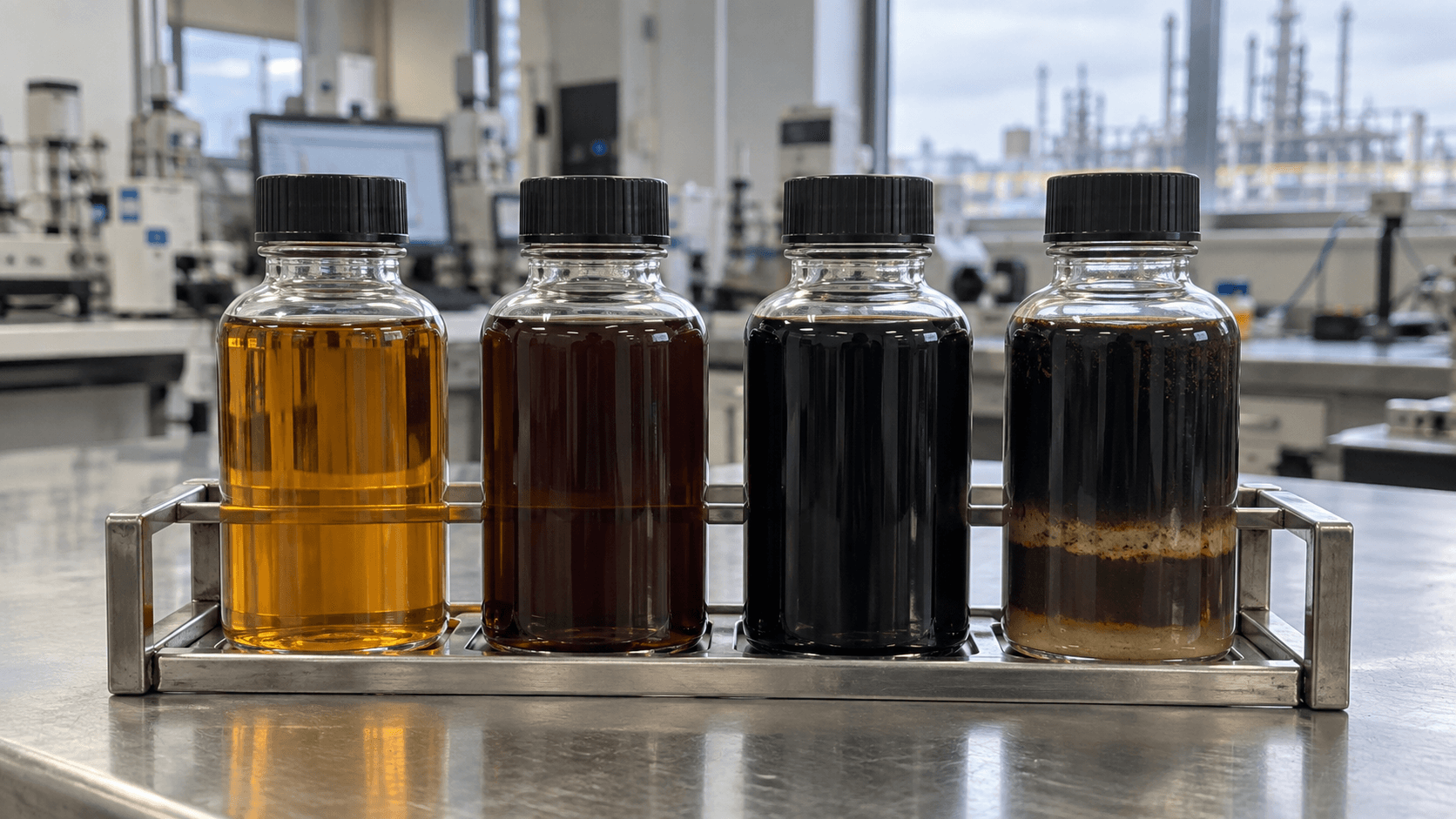
Crude oil is not a single fluid, and petroleum emulsions are not a single type of dispersion. Two crudes with similar API gravity can show very different emulsion stability because their asphaltenes, resins, waxes, acids, fine solids and production histories differ. Understanding crude composition and emulsion type is therefore fundamental to demulsifier selection.
1. How crude oils are classified
Crude oils are commonly described by density/API gravity, sulfur content and compositional character. These classifications are useful, but none alone predicts emulsion behavior.
2. API gravity: light, medium, heavy and extra-heavy crude
API gravity expresses crude density relative to water:
API gravity = (141.5 / specific gravity at 60 °F) − 131.5
API-gravity labels are conventions and the cutoffs vary by organization and market. One widely used petroleum-industry convention places light crude above about 31.1° API, medium around 22.3–31.1°, heavy below about 22.3°, and extra-heavy around or below 10° API. These ranges are descriptive categories, not universal physical transitions, so the classification source should be stated when the boundary matters.
Lower-API crude is often more viscous and can contain larger heavy-fraction concentrations, but API gravity alone does not determine whether a produced emulsion will be difficult to break.
3. Sweet and sour crude
Sweet/sour terminology primarily reflects sulfur content. Sour crude contains more sulfur compounds and generally requires greater sulfur-management effort during refining. Sulfur classification is important commercially and operationally but is not a direct measure of emulsion stability.
A sour crude can form an easy or difficult emulsion, just as a sweet crude can. For demulsification, interfacial-active components and production conditions are usually more directly relevant.
4. Paraffinic, naphthenic and aromatic character
Crudes are also described according to hydrocarbon character. Paraffinic crudes contain relatively more normal and branched alkanes and may have significant wax behavior. Naphthenic crudes contain more cycloalkanes, while aromatic-rich fractions contain more aromatic structures.
Real crude oils are complex mixtures rather than pure members of these categories. Their solvency environment influences whether asphaltenes remain well dispersed or approach conditions favorable for aggregation and interfacial accumulation.
5. SARA: a more useful compositional framework for emulsion science
SARA fractionation divides petroleum into Saturates, Aromatics, Resins and Asphaltenes. For emulsion behavior, the balance among these fractions can be more informative than density alone.
- Saturates: largely non-polar hydrocarbons, including paraffinic components.
- Aromatics: aromatic hydrocarbons with stronger solvency for heavy polar fractions than saturates.
- Resins: polar, aromatic-rich molecules that interact with asphaltenes and interfaces.
- Asphaltenes: operationally defined as the fraction insoluble in low-molecular-weight n-alkanes such as n-heptane but soluble in aromatic solvents such as toluene under the specified test definition.
Asphaltenes are not one unique molecule or molecular-weight class; they are a solubility-defined complex fraction.
6. Why asphaltenes are central to many crude-oil emulsions
Asphaltenes can adsorb at the oil–water interface and contribute to mechanically resistant, viscoelastic interfacial films. Their aggregation state and interfacial behavior depend on crude solvency, concentration, aromaticity and interactions with resins and other polar species.
However, “more asphaltene means more stable emulsion” is too simple. Reviews and model-oil studies show that stability depends strongly on asphaltene solvency/aggregation state, interfacial coverage and the surrounding oil composition; maximum stability can occur near conditions where asphaltenes approach incipient precipitation rather than at the highest bulk asphaltene concentration.
7. The role of resins
Resins can associate with asphaltenes, alter their solvency/dispersion in the oil phase and also participate at oil–water interfaces. Their effect is not unidirectional: depending on crude composition and concentration, resins may modify or weaken asphaltene-driven stabilization by keeping asphaltenes better solvated, while in other systems mixed interfacial films can contribute to stability.
Simple resin-to-asphaltene ratios are therefore useful descriptors in some model studies but should not be treated as universal predictors of bottle-test difficulty.
8. Waxes and paraffinic components
Wax can influence viscosity, low-temperature flow and emulsion behavior. Below or near the wax appearance region, precipitated wax crystals can interact with droplets and other interfacial materials. In waxy crude, temperature history may therefore change emulsion behavior even when bulk composition is unchanged.
9. Fine solids
Clay, silica, iron sulfide, corrosion products and other fine solids can accumulate at oil–water interfaces when their wettability is favorable, creating Pickering-type stabilization or reinforcing an organic interfacial film. Solid-stabilized emulsions can respond differently to conventional demulsifiers.
The effect depends on particle size, concentration, surface chemistry and oil/water wettability; solids are not automatically emulsion stabilizers under every condition.
10. Water-in-oil emulsions (W/O)
In a water-in-oil emulsion, water droplets are dispersed within a continuous crude-oil phase. This is the principal emulsion type encountered in crude dehydration and is the main target of conventional crude-oil demulsifiers.
W/O stability can be promoted by asphaltenes, resins, fine solids and other surface-active components that form or reinforce the droplet interface.
11. Oil-in-water emulsions (O/W)
In an oil-in-water emulsion, oil droplets are dispersed in a continuous aqueous phase. These systems are particularly relevant to produced-water treatment and oil-in-water discharge/reinjection quality.
A chemical optimized to break W/O crude emulsion should not automatically be assumed to treat O/W produced-water emulsion effectively. Phase continuity and required interfacial behavior are different.
12. Multiple emulsions: W/O/W and O/W/O
Multiple emulsions contain droplets within droplets. In a W/O/W system, small water droplets are trapped inside oil droplets that are themselves dispersed in an external water phase. O/W/O is the inverse architecture.
Such structures can arise under complex mixing, surfactant and phase-inversion conditions. In field fluids they complicate interpretation of simple visual separation because gross phase volume does not reveal the internal droplet structure.
13. Tight, loose and metastable emulsions
Field personnel often use terms such as “tight” and “loose” emulsion. These are operational descriptions rather than rigorous universal classifications. A tight emulsion generally refers to slow coalescence and persistent rag/interfacial material, while a loose emulsion separates more readily.
For technical reporting, these descriptions should be supported by measurable endpoints such as droplet-size distribution, separation kinetics, interface/rag volume and residual BS&W.
14. Droplet size
Smaller droplets generally settle more slowly and provide greater interfacial area per unit dispersed volume. High shear can therefore make an emulsion more difficult to separate by reducing droplet size and rapidly creating fresh interface for natural surface-active species to occupy.
Droplet size is not the only variable: a small-droplet emulsion with a weak interface may still break readily after appropriate treatment, while larger droplets with a strong interfacial film can persist.
15. Water cut and phase inversion
Changing dispersed-phase fraction alters droplet crowding, collision frequency, rheology and the probability of phase inversion. As water fraction rises, a W/O system may approach inversion toward O/W, but inversion is not controlled by water cut alone; crude composition, interfacial chemistry, wettability, temperature and imposed mixing/flow conditions can all shift the inversion region.
There is no universal water-cut percentage at which every crude inverts.
16. Temperature
Increasing temperature usually lowers crude viscosity and can increase droplet mobility and collision/coalescence rates. It also changes wax state, interfacial properties and demulsifier partitioning. Temperature therefore affects both the untreated emulsion and the chemical treatment.
This is why bottle testing at an arbitrary laboratory temperature can produce a ranking that differs from field behavior.
17. Salinity and brine composition
The dispersed water is chemically active. Ionic strength and specific ions can influence interfacial charge, ionization of acidic/basic surface-active species, mineral/solid behavior and interactions within the interfacial film. Ca²⁺, Mg²⁺, Fe species and the overall brine composition can therefore change emulsion behavior even when the crude oil is unchanged.
18. pH and naturally occurring acids/bases
Crude oils can contain naphthenic acids and basic nitrogen compounds. Their ionization at the interface depends on aqueous pH. Changes in pH can alter interfacial charge and the surface activity of naturally occurring species, sometimes producing large changes in emulsion stability.
19. Emulsion ageing
A freshly generated emulsion can behave differently after hours or days. Interfacial films can reorganize and become more mechanically resistant with time. Asphaltene aggregation and solid association may also evolve.
Sample age is therefore a critical bottle-test variable. Comparing one product on fresh emulsion with another on aged emulsion is not a valid chemical comparison.
20. How crude characteristics affect demulsifier selection
| Crude/system characteristic | Possible emulsion consequence | Demulsifier-selection implication |
|---|---|---|
| High viscosity | Slower droplet movement and film drainage | Temperature and separation kinetics become especially important |
| Asphaltene-rich/interfacially active crude | Strong viscoelastic interfacial film may form | Screen chemistries able to disrupt/reorganize the native film |
| Waxy crude | Temperature-history-dependent viscosity and solid effects | Test at representative temperature and ageing history |
| Fine solids present | Possible Pickering/interfacial reinforcement | Assess solids and interface rather than water drop alone |
| Very small droplets | High interfacial area and slow gravity separation | Mixing history and coalescence kinetics become critical |
| Changing brine/pH | Changed interfacial chemistry | Use representative produced water in screening |
| Changing water cut | Droplet crowding and possible phase-behavior change | Evaluate across realistic water-cut range |
21. Why the same demulsifier can succeed in one crude and fail in another
A demulsifier must reach the interface and alter a film whose composition is determined by the crude and brine. Changing asphaltene/resin balance, aromatic solvency, solids, wax, water chemistry or droplet size changes that target.
Consequently, an EO/PO polyether, resin alkoxylate, branched polyether or blend that is well matched to one crude may have the wrong partitioning or interfacial behavior in another.
22. Crude classification is a starting point, not a demulsifier prescription
Labels such as “heavy,” “sour” or “paraffinic” help describe crude, but they should not be converted directly into a product recommendation. A technically useful screening package combines crude characterization with representative bottle testing.
At minimum, record API/density, viscosity at relevant temperature, initial water/BS&W, brine chemistry where available, sample age, operating temperature, water cut and evidence of wax or solids. SARA data can add valuable context when emulsion behavior is difficult to explain.
23. A practical diagnostic sequence
- Identify whether the problematic dispersion is W/O, O/W or a more complex system.
- Record crude density/API, viscosity and temperature.
- Measure water content and characterize produced-water chemistry where relevant.
- Review SARA/asphaltene information if available.
- Check for wax, solids and corrosion products.
- Document sample age and upstream shear/mixing history.
- Run a controlled bottle-test dose response using the representative emulsion.
- Judge water drop, interface, water quality and final oil BS&W together.
- Validate shortlisted chemistry under field conditions.
Frequently asked questions
Does heavy crude always form the most stable emulsion?
No. Heavy crude often has high viscosity and significant heavy polar fractions, but emulsion stability depends on interfacial composition, droplet size, solids, water chemistry, shear and ageing as well as density.
Does high asphaltene content always mean a difficult bottle test?
No. Asphaltene state, solvency, aggregation and interfacial coverage matter. Bulk concentration alone is not a universal predictor.
Are all produced crude emulsions water-in-oil?
No. W/O is common in crude dehydration, but O/W and multiple emulsions also occur, particularly in produced-water and high-water-cut systems.
Can API gravity be used to choose a demulsifier base?
Not by itself. API is useful context, but demulsifier selection requires information about interfacial-active crude components, brine, process conditions and actual bottle-test response.
Conclusion
Crude-oil emulsion behavior emerges from the interaction of bulk crude composition, interfacial-active molecules, dispersed-water chemistry, solids and process history. API gravity, sulfur classification and SARA composition each describe different parts of that system.
For demulsification, the most useful question is not simply “What type of crude is this?” but “What stabilizes this particular oil–water interface under the actual production conditions?” Answering that question connects crude characterization to demulsifier base chemistry, bottle testing and ultimately field performance.
Technical references
- Kokal, S. L. Crude-Oil Emulsions: A State-of-the-Art Review. SPE Production & Facilities 2005, 20, 5–13. DOI: 10.2118/77497-PA.
- Kilpatrick, P. K. Water-in-Crude Oil Emulsion Stabilization: Review and Unanswered Questions. Energy & Fuels 2012, 26, 4017–4026. DOI: 10.1021/ef3003262.
- McLean, J. D.; Kilpatrick, P. K. Effects of Asphaltene Solvency on Stability of Water-in-Crude-Oil Emulsions. Journal of Colloid and Interface Science 1997, 189, 242–253.
- Sjöblom, J. et al. Our current understanding of water-in-crude oil emulsions: Recent characterization techniques and high pressure performance. Advances in Colloid and Interface Science 2003, 100–102, 399–473.
- Speight, J. G. The Chemistry and Technology of Petroleum. CRC Press.
Related Horizons Apex resources: Demulsifier Base Chemistries, Demulsifier Bottle Test Method, Selecting a Demulsifier, and Demulsifiers.