
Crude Oil Dehydration and Desalting Systems: Gravity, Coalescers, Heater-Treaters and Electrostatic Separation
Demulsification · Process Systems
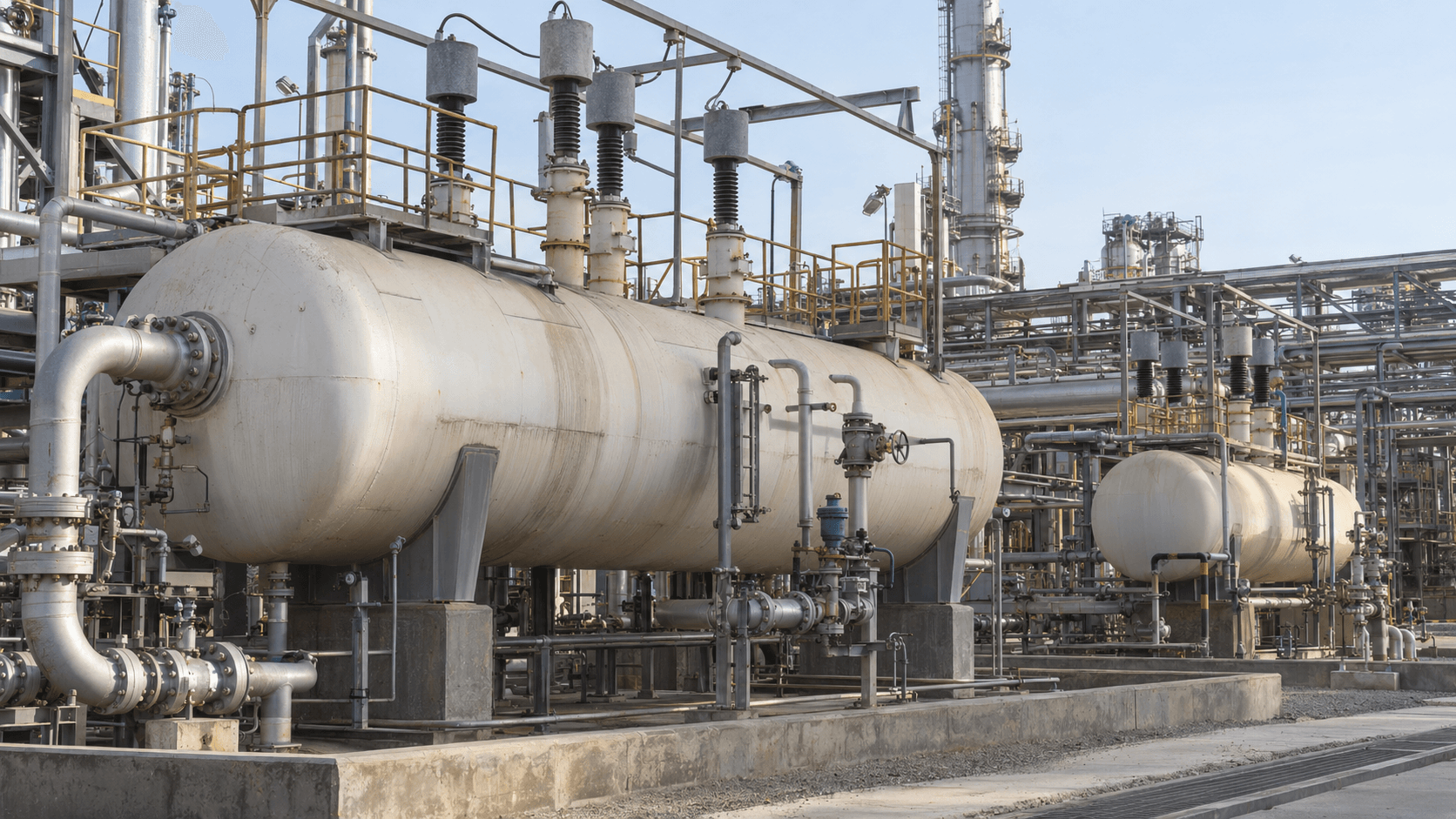
Crude-oil dehydration and desalting facilities differ fundamentally in how they create droplet contact, coalescence and phase separation. Some systems rely mainly on gravity and long residence time; others add heat, coalescing internals or high-voltage electrostatic fields. Modern facilities often combine several mechanisms. Because the separation environment changes, the demulsifier that performs best in one system may not be optimal in another.
1. Dehydration and desalting are related but different
Produced crude can contain free water, dispersed/emulsified water and dissolved salts carried in the aqueous phase. Dehydration primarily reduces water content. Desalting adds wash-water contact so water-soluble salts can transfer into a new aqueous phase that is subsequently separated. A dehydrator can therefore produce low BS&W while salt remains excessive if the residual brine is highly saline.
2. Gravity / high-residence-time systems
Large settling vessels and wash tanks rely substantially on gravity and time. Droplet settling becomes faster as droplets grow and slower as continuous-phase viscosity increases. Real crude emulsions are more complex than ideal Stokes settling, but this explains why small droplets and viscous crude challenge gravity systems.
Strengths: simplicity and long separation time. Limitations: large inventory/footprint, slow response and limited ability to overcome very stable fine emulsions without chemical or thermal assistance.
3. Demulsifier behavior in long-residence systems
With more residence time, sustained coalescence, final dehydration and interface cleanup may matter more than the first few minutes of water drop. The correct kinetic target should reflect actual throughput and residence time rather than an arbitrary bottle-test endpoint.
4. Coalescer-based systems
Coalescers intentionally increase droplet contact and merger using engineered internals or media. Once small water droplets combine into larger droplets, gravitational separation becomes easier. This is different from simply providing a larger empty settling volume.
Performance depends on droplet size, viscosity, wettability, interfacial film strength, solids and flow distribution. Fine solids, wax or sludge can foul media, and incorrect wetting can reduce efficiency. Demulsifier compatibility with the coalescing surface therefore matters.
5. Heater-treaters
Heating generally reduces crude viscosity and can accelerate droplet movement, film drainage and coalescence. Heater-treaters combine thermal assistance with residence time, gravity and usually chemical treatment. Energy demand, vapor handling, fouling, scaling, corrosion and crude-quality constraints limit the usable temperature window.
Temperature also changes wax state and demulsifier solubility, diffusion and partitioning. A formulation can therefore rank differently when treating temperature changes.
6. Electrostatic dehydration
Electrostatic treaters apply a high-voltage field to a water-in-oil dispersion. The field can polarize droplets and generate electrostatic interactions that increase droplet approach and collision; successful separation still requires liquid-film drainage and rupture before true coalescence occurs. Larger coalesced droplets then separate more readily by gravity.
Electrostatic treatment does not remove the need for appropriate interfacial chemistry. If the native asphaltene/resin/solid film remains too resistant, collisions may not lead to efficient coalescence. Chemical and electrostatic mechanisms are therefore commonly complementary.
7. AC, DC and combined field concepts
Industrial electrostatic separators use different electrical configurations. AC fields are historically the most widely used in petroleum electrocoalescence, while pulsed-DC and combined/dual-polarity concepts are also used in research and commercial designs. It is not defensible to call one waveform universally superior: electrode geometry and insulation, field strength/frequency, crude electrical properties, water fraction and droplet distribution all interact, and optimum conditions are equipment- and fluid-specific.
8. Electrical stability
High water levels, conductive pathways or droplet chains, unstable rag, solids and unresolved emulsion can disturb electrostatic operation and may contribute to high or erratic electrical load or short-circuit/arcing risk depending on electrode and power-system design. Outlet BS&W alone is therefore not a complete electrostatic-treatment KPI.
9. Electrostatic desalting
Desalting couples dilution/mass transfer with separation. Added wash water contacts the saline water already associated with the crude, diluting and redistributing water-soluble inorganic salts into the aqueous phase; that salt-bearing water must then coalesce and leave the oil. The process therefore requires both effective water contact and effective subsequent separation.
10. Mixing: too little versus too much
Insufficient mixing gives poor wash-water/brine contact and weak salt transfer. Excessive shear can create very small droplets and a large interfacial area, making downstream separation more difficult. The optimum mixing-valve pressure drop or shear is system-specific; more mixing is not automatically better desalting.
11. Single-stage desalting
A single-stage desalter performs the principal wash-water contacting and separation in one stage. It can be adequate when inlet salt, crude properties and outlet specifications allow the required removal. It has fewer equipment stages but less margin when feed or specification becomes more demanding.
12. Two-stage / multistage desalting
A second stage provides another opportunity for dilution/contact and brine removal. Wash water may be reused between stages or arranged countercurrently depending on design. Two-stage systems can achieve more demanding salt removal, but add equipment, controls and operating complexity.
13. Hybrid systems
Many real facilities combine chemical demulsifier, heat, controlled mixing, residence time and electrostatic coalescence. Upstream free-water removal or engineered coalescing internals may also be present. A facility is therefore best understood by its dominant mechanisms and operating envelope rather than by one equipment label.
14. Upstream free-water removal
Where bulk free water is high, removing it upstream can reduce the hydraulic, thermal and electrical load on downstream fine dehydration/desalting. However, upstream shear, chemical injection and interface control affect the droplet population entering the next vessel, so the whole separation train should be evaluated together.
15. Comparison of system types
| System | Dominant mechanism | Strength | Main limitation | Demulsifier focus |
|---|---|---|---|---|
| Gravity / high residence | Settling + coalescence | Simple, long time | Large volume; fine droplets | Final dehydration, clean interface |
| Coalescer | Droplet contact on internals | Compact enhanced coalescence | Fouling/wettability | Film weakening + media compatibility |
| Heater-treater | Heat + gravity + time | Lower viscosity | Energy/fouling | Performance at treating temperature |
| Electrostatic dehydrator | Electric-field coalescence | Fine water removal | Electrical/interface sensitivity | Rapid clean coalescence |
| Electrostatic desalter | Wash-water contact + field | Water + salt reduction | Mixing/separation trade-off | Salt, BS&W, water quality, electrical stability |
| Two-stage desalter | Repeated contact/separation | Higher salt-removal capability | Complexity | Robust performance across stages |
16. Why bottle-test ranking can change by facility
A gravity bottle test evaluates chemical-assisted coalescence and settling under defined temperature and mixing. It does not reproduce a high-voltage field, engineered coalescer media, continuous wash-water mixing or full-scale hydraulics. A bottle-test winner in a long-residence tank is therefore not automatically the optimum product for a short-residence electrostatic unit.
17. Demulsifier priorities by system
High residence time: final dehydration, low residual BS&W and clean interface.
Coalescer: rapid film weakening plus compatibility with internals and solids.
Heater-treater: partitioning and performance at actual temperature.
Electrostatic dehydration: rapid coalescence, interface stability and electrical operability.
Desalting: salt removal together with BS&W, wash-water quality, rag behavior and electrical stability.
18. High outlet BS&W
Possible causes include unsuitable dose/chemistry, low temperature, reduced residence time, excessive upstream shear, changed crude/water cut/solids, poor level control, hydraulic maldistribution, or electrostatic/coalescer malfunction.
19. High salt despite acceptable BS&W
Low water content does not guarantee low salt. A small residual volume of highly saline brine can still produce unacceptable salt. Poor wash-water contact, insufficient wash-water quality/rate, high inlet salinity or weak stage efficiency should be investigated.
20. Thick rag layer
Rag can contain partially coalesced water, oil, asphaltenic material, solids and treatment chemicals. Crude changes, solids, temperature, interface level, mixing and chemical dose/partitioning should be investigated. Simply increasing demulsifier dose can sometimes worsen the interface.
21. Dirty effluent water
Oil-rich water can indicate excessive dispersion, poor coalescence, unfavorable chemical partitioning, interface disturbance or hydraulic carry-under. Water quality should be part of demulsifier selection rather than an afterthought.
22. Electrical instability
High or erratic electrical load should be investigated against water level, rag/emulsion condition, conductivity, solids, electrodes and electrical controls. Chemical adjustment can help when unresolved emulsion is the cause, but electrical/mechanical faults should not be treated as chemistry problems.
23. Troubleshooting matrix
| Symptom | Process variables | Chemical questions |
|---|---|---|
| High BS&W | Temperature, residence, shear, level | Dose, chemistry, injection/distribution |
| High salt | Wash water, mixing, inlet salinity, stages | Does treatment allow clean brine coalescence? |
| Thick rag | Solids, crude blend, temperature, level | Overdose? partitioning? film disruption? |
| Dirty water | Mixing, hydraulics, interface | Is chemistry transferring/stabilizing oil in water? |
| Electrical instability | Water level, conductivity, rag, electrodes | Is unresolved emulsion contributing? |
24. Facility-specific evaluation workflow
- Map the separation train and dominant mechanism at each vessel.
- Record crude, inlet BS&W/salt, water cut, temperature and throughput.
- Identify effective residence time and upstream shear points.
- For desalters, document wash-water quality/rate and mixer conditions.
- For electrostatic units, review electrical behavior with interface condition.
- Design bottle testing around representative temperature, phase ratio and mixing.
- Evaluate water drop, interface, final BS&W and water quality; for desalting also measure salt removal.
- Validate shortlisted candidates through controlled field dosage steps.
Frequently asked questions
Is electrostatic treatment always better than long residence time?
No. Equipment choice depends on throughput, crude properties, specification, footprint, utilities and operating requirements.
Does electrostatic dehydration eliminate demulsifier?
Not generally. A strong natural interfacial film can prevent coalescence even when droplets collide in an electric field.
Can a conventional bottle test fully predict desalter performance?
No. It does not reproduce the electric field, continuous wash-water mixing, full-scale hydraulics or electrical stability.
Why can salt stay high when BS&W is low?
Because salt is dissolved in residual aqueous droplets. A small amount of highly saline brine can still produce unacceptable salt.
Conclusion
Crude dehydration and desalting systems form a spectrum from gravity/high-residence-time separation to engineered coalescers, heater-treaters and high-voltage electrostatic units. Modern plants frequently combine these mechanisms.
Demulsifier selection should therefore begin with the facility, not only the crude. Residence time, temperature, mixing, coalescing mechanism, electrical field, wash-water contact, interface control and outlet specifications determine what good performance means.
Technical references
- Kokal, S. L. Crude-Oil Emulsions: A State-of-the-Art Review. SPE Production & Facilities 2005, 20, 5–13. DOI: 10.2118/77497-PA.
- Kilpatrick, P. K. Water-in-Crude Oil Emulsion Stabilization: Review and Unanswered Questions. Energy & Fuels 2012, 26, 4017–4026. DOI: 10.1021/ef3003262.
- Speight, J. G. The Chemistry and Technology of Petroleum. CRC Press.
Related Horizons Apex resources: Crude Oil Types and Petroleum Emulsions, Demulsifier Base Chemistries, and Demulsifier Bottle Test Method.