
How to Evaluate Oilfield Corrosion Inhibitors: Wheel Test, LPR, Rotating Methods and Flow Loops
Corrosion Control · Laboratory Evaluation
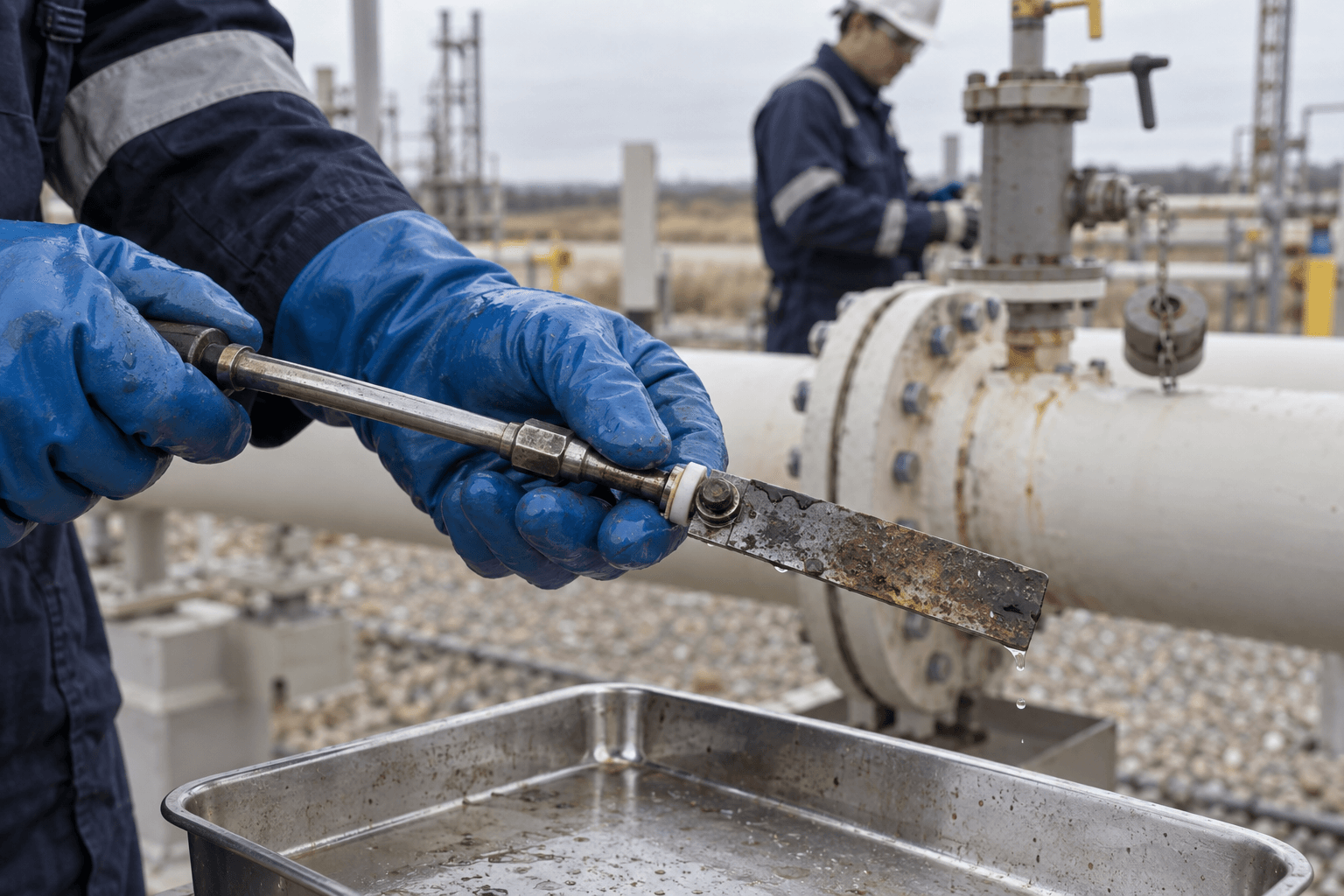
No single laboratory method can fully reproduce oilfield corrosion-inhibitor performance. A reliable evaluation programme uses complementary methods: gravimetric tests show cumulative metal loss, electrochemical methods such as linear polarization resistance (LPR) provide rapid corrosion-response data, rotating methods impose controlled hydrodynamic challenge, and HPHT or flow-loop tests can reproduce more of the field environment.
This article explains the principal methods used to evaluate oilfield corrosion inhibitors, with special attention to the historical NACE 1D182 wheel-test method, LPR, rotating-cylinder and rotating-cage methods, and the logic for progressing from screening to field validation.
1. Start with the question the test must answer
A corrosion-inhibitor test should be selected from the field decision, not from laboratory convenience. Important variables include metallurgy, CO₂/H₂S, brine chemistry, pH, temperature, pressure, water cut, hydrocarbon phase, inhibitor concentration, treatment mode, surface condition and hydrodynamics.
ASTM G170 frames laboratory qualification around compact, scalable and hydrodynamically characterized methods, while recognizing that field evaluation remains necessary. The current guide identifies rotating cylinder electrode (RCE), rotating cage (RC) and jet impingement (JI) as principal compact controlled-flow methodologies and discusses flow loops as more sophisticated, costly and time-consuming systems.
2. Weight-loss coupons: the gravimetric foundation
Weight-loss testing determines cumulative metal loss over a known exposed area and test duration. After exposure, corrosion products are removed by a defined cleaning procedure and the mass change is converted to an average corrosion rate.
The method is direct and robust, but it is time-integrated rather than real-time. An average mass-loss value can also hide localized attack. Coupon evaluation should therefore include visual and, where relevant, quantitative examination for pitting or non-uniform corrosion.
3. NACE 1D182 wheel test
NACE 1D182, Wheel Test Method Used for Evaluation of Film-Persistent Corrosion Inhibitors for Oilfield Applications, is a historical NACE laboratory method specifically associated with wheel testing of film-persistent oilfield corrosion inhibitors. The method uses sealed test containers containing defined fluids and steel specimens that are rotated on a wheel to provide repeated wetting/agitation under controlled exposure.
The wheel test is fundamentally a gravimetric screening/qualification approach rather than an electrochemical real-time technique. Its strength is the ability to compare several formulations or dosages under the same controlled exposure and, in film-persistence designs, to distinguish the filming stage from subsequent corrosive exposure.
Its limitation is equally important: rotation of bottles on a wheel does not reproduce a defined pipeline flow regime or wall shear stress. Results are useful for comparative ranking under the stated method, but should not be presented as direct simulation of field hydrodynamics. Historical NACE documentation also cautions about laboratory reproducibility and the need for strict procedural control.
4. NACE 1D196 and the broader oilfield test framework
Historical NACE publication 1D196, Laboratory Test Methods for Evaluating Oil-Field Corrosion Inhibitors, appears in the technical lineage of oilfield inhibitor laboratory methodology. It should not be confused with similarly numbered NACE test methods addressing unrelated materials. Because 1D196 is historical rather than the current controlling ASTM practice, this article uses current ASTM G170/G184/G185/G208 documents for present-day method descriptions.
The practical lesson from the NACE/ASTM framework is that different laboratory methods answer different questions. Static or wheel tests can screen chemistry; controlled-flow methods can challenge films under defined hydrodynamics; electrochemical techniques can track response with time; and more complex systems can be used when pressure, temperature or multiphase flow materially affect the application.
5. LPR — Linear Polarization Resistance
LPR is an electrochemical technique used to estimate corrosion rate near the open-circuit or corrosion potential. A small polarization is applied around the corrosion potential and the resulting current response is used to determine the polarization resistance, Rp. Under appropriate conditions, the Stern–Geary relationship links Rp to corrosion current density:
icorr = B / Rp
where the Stern–Geary constant B depends on the anodic and cathodic Tafel slopes. Corrosion current density can then be converted to an estimated penetration rate using the relevant equivalent weight and density.
The major advantage of LPR is speed. It can follow changes in corrosion response during inhibitor addition, dosage changes or environmental changes without waiting for a long coupon exposure.
However, LPR is not simply an electronic replacement for a coupon. Its quantitative accuracy depends on assumptions including appropriate B value, sufficiently conductive electrolyte, electrode condition and approximately linear polarization behavior near the corrosion potential. Localized corrosion can also be poorly represented by a single average electrochemical rate. For critical inhibitor qualification, LPR and physical surface/coupon evidence are complementary.
6. RCE — Rotating Cylinder Electrode
The rotating cylinder electrode provides a controlled rotating metal surface and is widely used to study corrosion and inhibitor performance under defined mass-transfer conditions. Rotation speed can be varied systematically, allowing hydrodynamic severity to be changed in a reproducible manner.
Because the cylinder is a working electrode, RCE can be combined with electrochemical measurements, including polarization-resistance approaches, to obtain time-resolved information while an inhibitor film forms or is challenged. ASTM G185 is the dedicated current ASTM practice for oilfield/refinery inhibitor evaluation using the rotating cylinder electrode.
RCE does not reproduce every feature of multiphase pipeline flow, but it is substantially more controlled hydrodynamically than a bottle wheel test.
7. Rotating Cage
ASTM G184 covers evaluation of corrosion inhibitors using a rotating cage. Multiple coupon specimens are mounted around a rotating cage, allowing several surfaces or treatments to be exposed under the same bulk environment while rotational speed creates controlled agitation.
A key advantage is the use of conventional coupon specimens with a stronger hydrodynamic component than static immersion. It is useful for comparative inhibitor qualification, particularly when post-test mass loss and surface condition are important.
Rotating cage and RCE should not be treated as synonyms. RCE uses a cylindrical working electrode and is especially compatible with electrochemical measurements; rotating-cage methods expose multiple coupon specimens and are naturally suited to gravimetric and surface evaluation.
8. Jet impingement
Jet-impingement methods direct a fluid jet at the test surface to create high local mass transfer and hydrodynamic stress. ASTM G170 includes jet impingement among its compact controlled-flow approaches, and ASTM G208 is the dedicated ASTM practice for evaluating and qualifying oilfield/refinery corrosion inhibitors using jet-impingement apparatus.
The method can be valuable when inhibitor films must be challenged under severe local flow. The resulting hydrodynamic field is nevertheless specific to the apparatus and should not be interpreted as identical to all pipeline geometries.
9. Autoclave and HPHT testing
When temperature, total pressure or acid-gas partial pressure materially affect corrosion and inhibitor chemistry, pressurized autoclave testing becomes important. HPHT tests can reproduce CO₂ and, with appropriate specialized facilities and safety controls, H₂S-containing environments more realistically than atmospheric bottle tests.
Pressure capability alone does not guarantee field relevance. Mixing, phase ratio, gas composition, brine chemistry, surface preparation and exposure history still need to match the question being investigated.
10. Flow-loop testing
A flow loop offers the greatest opportunity among common laboratory methods to reproduce pipeline-like transport, multiphase distribution and controlled flow regime. It can investigate inhibitor delivery, adsorption/desorption, water wetting and film persistence under more realistic hydrodynamics.
The trade-off is complexity, cost and experimental control. ASTM G170 notes that flow loops can provide sophisticated flow simulation but are not always practical for routine inhibitor screening. They are most valuable after less expensive methods have narrowed the candidate set or when hydrodynamics are central to the field failure mechanism.
11. Surface examination and localized corrosion
Corrosion inhibitor qualification should not stop at one average corrosion-rate number. After exposure, the steel surface can reveal pitting, localized attack, under-deposit effects or non-uniform film performance that is not obvious from average mass loss or LPR.
Depending on the objective, post-test evaluation can include cleaned-coupon visual inspection, pit-depth measurement, optical microscopy, profilometry or other surface characterization. The method should be proportionate to the integrity risk and test purpose.
12. Supporting tests beyond corrosion rate
- Solubility and dispersibility: can the formulation be delivered in the intended fluids?
- Oil/water partitioning: where does the active chemistry reside in a multiphase system?
- Compatibility: does it interact adversely with demulsifiers, scale inhibitors, biocides or other chemicals?
- Emulsion tendency: does the corrosion inhibitor worsen separation or water quality?
- Foaming: can surface activity create process problems?
- Thermal/chemical stability: does the active chemistry change during storage or field exposure?
13. Comparison of the main methods
| Method | Main output | Real-time? | Hydrodynamic control | Main strength | Main limitation |
|---|---|---|---|---|---|
| Weight-loss coupon | Average cumulative corrosion + surface | No | Depends on apparatus | Direct metal-loss evidence | Time-integrated; average can hide localized attack |
| NACE 1D182 wheel test | Comparative gravimetric inhibition / film persistence | No | Low-to-moderate, not pipeline-defined | Simple comparative screening | Does not reproduce defined field shear/flow regime |
| LPR | Estimated instantaneous corrosion rate | Near-real-time | Depends on cell | Rapid response to treatment changes | Requires electrochemical assumptions; localized corrosion may be missed |
| RCE | Electrochemical + controlled rotation | Yes, with electrochemistry | Controlled | Reproducible mass-transfer challenge | Not a complete multiphase pipeline simulation |
| Rotating cage | Coupon mass loss + surface | No | Controlled rotational agitation | Multiple specimens under one condition | Hydrodynamics are apparatus-specific |
| Jet impingement | Corrosion under high local flow | Method-dependent | Controlled, localized | High-shear/mass-transfer challenge | Local jet field differs from many pipeline flows |
| Autoclave/HPHT | Corrosion under pressure/temperature | Method-dependent | Depends on mixing system | Representative gas pressure and temperature | Complexity and safety requirements |
| Flow loop | Corrosion/film behavior under flowing system | Can be | Highest field-flow relevance | Multiphase and transport realism | Cost, complexity and lower screening throughput |
14. A practical qualification sequence
- Define the field threat: fluids, gases, metallurgy, temperature, pressure and hydrodynamics.
- Screen: use controlled coupon/wheel testing to eliminate clearly weak candidates.
- Measure kinetics: use LPR or another electrochemical technique to understand response and film establishment where appropriate.
- Challenge hydrodynamics: use RCE, rotating cage or jet impingement when flow sensitivity matters.
- Reproduce critical environment: use autoclave/HPHT or flow-loop testing when pressure, temperature, gas composition or multiphase flow are decisive.
- Inspect surfaces: evaluate localized attack as well as average corrosion rate.
- Validate in the field: combine treatment-delivery data with coupons, LPR/ER probes, inspection and operating conditions.
15. Why different methods can rank inhibitors differently
A candidate that performs strongly in a wheel test may not rank first in an RCE or flow loop. This does not automatically mean one test is wrong. The methods expose the inhibitor to different mass transfer, film formation, shear, surface histories and measurement timescales.
The correct interpretation is therefore application-specific: a ranking is meaningful only in relation to the conditions and decision represented by the test.
Frequently asked questions
Is NACE 1D182 the same as LPR?
No. NACE 1D182 is a wheel-test approach based primarily on controlled exposure and gravimetric/surface evaluation of film-persistent inhibitors. LPR is an electrochemical method that estimates corrosion current from polarization resistance.
Can LPR replace weight-loss coupons?
Not universally. LPR provides rapid corrosion-response information, while coupons provide cumulative physical metal-loss and surface evidence. Using both can provide stronger qualification than either alone.
Is rotating cage the same as RCE?
No. A rotating cage carries multiple coupon specimens; an RCE is a rotating cylindrical working electrode designed for controlled hydrodynamics and electrochemical measurement.
Which method is closest to field conditions?
A well-designed flow loop can reproduce more pipeline transport and multiphase hydrodynamics than simpler methods, but “closest” depends on which field variables are important. HPHT autoclaves may be more relevant when pressure, temperature or gas composition dominate.
Conclusion
Oilfield corrosion-inhibitor evaluation is strongest when methods are combined rather than treated as competitors. NACE 1D182 wheel testing and conventional coupons provide valuable comparative gravimetric evidence. LPR adds rapid electrochemical response. RCE, rotating cage and jet impingement introduce controlled hydrodynamic challenge. Autoclaves and flow loops extend qualification toward pressure, temperature and field-like transport.
The goal is not to find the laboratory test that produces the lowest corrosion number. It is to build a chain of evidence that explains whether an inhibitor can be delivered, adsorb, form or maintain protection, control both uniform and localized corrosion, and remain effective under the actual operating envelope.
Standards and technical references
- NACE 1D182, Wheel Test Method Used for Evaluation of Film-Persistent Corrosion Inhibitors for Oilfield Applications.
- NACE 1D196, Laboratory Test Methods for Evaluating Oil-Field Corrosion Inhibitors (historical NACE publication cited by ASTM G170).
- ASTM G170-26, Standard Guide for Evaluating and Qualifying Oilfield and Refinery Corrosion Inhibitors in the Laboratory.
- ASTM G184-06(2024), Standard Practice for Evaluating and Qualifying Oil Field and Refinery Corrosion Inhibitors Using Rotating Cage.
- ASTM G185-06(2024), Standard Practice for Evaluating and Qualifying Oil Field and Refinery Corrosion Inhibitors Using the Rotating Cylinder Electrode.
- ASTM G208-12(2024), Standard Practice for Evaluating and Qualifying Oilfield and Refinery Corrosion Inhibitors Using Jet Impingement Apparatus.
- ASTM G59, Standard Test Method for Conducting Potentiodynamic Polarization Resistance Measurements.
- ASTM G102, Standard Practice for Calculation of Corrosion Rates and Related Information from Electrochemical Measurements.
Related Horizons Apex resources: Corrosion Inhibitors, Why Even a Good Corrosion Inhibitor Can Fail in the Field, Imidazoline vs. Quaternary Ammonium Corrosion Inhibitors, and Gas Corrosion Inhibitors & Dosage Calculations.