
Imidazoline vs. Quaternary Ammonium Corrosion Inhibitors in Oil & Gas
Corrosion Control · Chemistry Comparison
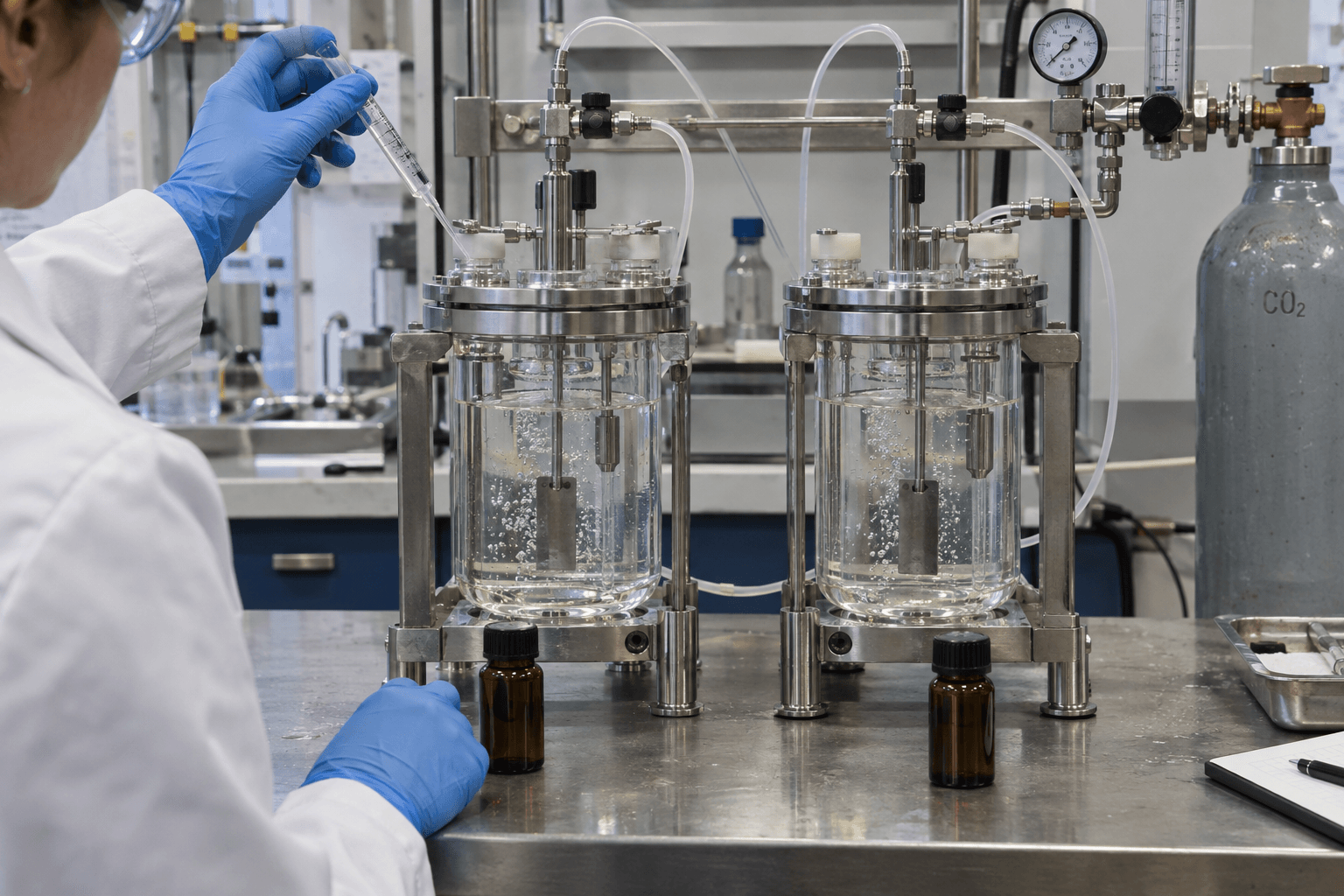
Imidazoline-based inhibitors and quaternary ammonium compounds (quats) are two important corrosion-inhibitor families used and studied in oil and gas service, but they are not interchangeable categories. Their structures, charge states, solubility, adsorption behavior and stability can differ substantially. An additional source of confusion is that an imidazoline can itself be quaternized, producing an imidazoline quaternary ammonium salt that belongs to both descriptions.
1. First clarify the chemistry
Imidazoline describes a five-membered nitrogen-containing heterocycle. Oilfield film-forming inhibitors commonly described as imidazolines often contain a long hydrophobic hydrocarbon chain derived from fatty-acid feedstock and a nitrogen-rich polar region.
A quaternary ammonium compound contains a permanently positively charged nitrogen bearing four organic substituents. The quat family is broad: long-chain alkyl ammonium salts, pyridinium and quinolinium salts, gemini quats and quaternized imidazoline derivatives are chemically different members of this class.
For technical discussion, three cases should therefore be separated: non-quaternized imidazoline-based inhibitor; non-imidazoline quat; and quaternized imidazoline.
2. How imidazoline-based inhibitors are made
At reaction-pathway level, a common oilfield route starts from a fatty acid or fatty-acid mixture and a polyamine. Tall-oil fatty acid (TOFA) and diethylenetriamine (DETA) are a well-documented example. Amide/amidoamine formation is followed by dehydration and ring closure to produce imidazoline-containing chemistry.
An industrial “imidazoline inhibitor” should not automatically be assumed to be one pure molecule. Detailed work on TOFA/DETA chemistry has described reaction blends containing imidazoline and its amidoamine precursor, and aqueous exposure can further change composition through hydrolysis.
3. How quat inhibitors are made
A quat is commonly produced by quaternizing a suitable tertiary amine or nitrogen heterocycle with an alkylating reagent, yielding a permanently charged quaternary ammonium center. The precursor and alkylating chemistry determine whether the product is an alkyl ammonium, pyridinium, quinolinium, gemini or another quaternary structure. This is a general synthetic description; exact industrial routes are structure-specific.
Quaternization can also be performed on an imidazoline-containing precursor. The resulting imidazoline quaternary ammonium salt should not be treated as chemically identical to either the original free-base imidazoline or a simple non-imidazoline quat.
4. Charge state: a fundamental difference
A conventional quaternary ammonium center carries a permanent positive charge. A non-quaternized imidazoline-based molecule can instead change protonation state with solution chemistry. In a published TOFA/DETA study in CO₂-saturated 3 wt% NaCl brine at about pH 4.1, the inhibitor was reported to be fully protonated; protonation increased solubility/dispersibility and supported adsorption of positively charged inhibitor species. This specific result should not be generalized to every imidazoline or pH.
5. How imidazoline-based inhibitors work
The dominant framework is adsorption and protective film formation. The nitrogen-containing polar region interacts with the steel/corrosion-product interface while the hydrophobic chain contributes to formation of an organic barrier that reduces contact between the corrosive aqueous phase and active surface sites.
Studies of TOFA/DETA systems demonstrate adsorption and effective inhibition in CO₂-containing chloride media. Real field films, however, need not be ideal monolayers: steel may carry FeCO₃, FeS, scale, deposits and pre-existing corrosion products, and commercial formulations can contain several active species.
6. How quats work
Quats also act primarily through adsorption at the steel/solution interface. Electrostatic interactions can contribute, while heteroatoms, aromatic groups, hydrophobic chains and molecular architecture can provide additional physical or chemical adsorption interactions. The adsorbed layer impedes charge transfer and access of corrosive species.
Oilfield-relevant literature reports inhibition by non-imidazoline quats including pyridinium salts, long-chain alkyl ammonium salts and gemini quaternary surfactants. Their performance can change substantially between CO₂-only and CO₂/H₂S media because sulfide species, corrosion products and surface chemistry change.
7. What quaternization changes
Quaternization creates a permanently charged nitrogen center and can materially change aqueous dispersibility, adsorption and formulation behavior. It is therefore reasonable to treat imidazoline quaternary ammonium salts as a distinct subclass.
Quaternization is not automatically an upgrade. Whether it improves performance depends on brine chemistry, temperature, hydrocarbon phase, surface condition, concentration, flow and compatibility with the rest of the chemical programme.
8. Hydrolysis and stability
Peer-reviewed work on TOFA/DETA inhibitor blends has demonstrated acid-catalysed hydrolysis of imidazoline and amidoamine components in CO₂-saturated brine, accelerated by exposure time and temperature. Aged chemistry showed different effects on uniform and localized corrosion compared with fresh inhibitor.
This does not mean all imidazolines are unsuitable or that their hydrolysis products are inactive. It means the species present after storage and field exposure can matter. Quats avoid protonation/deprotonation at the quaternary center, but permanent charge does not make every quat universally more thermally or chemically stable; stability remains structure-dependent.
9. Solubility, dispersibility and delivery
In multiphase production, an inhibitor must reach the steel where the corrosive aqueous phase contacts it. Hydrophobic chains, protonation, salt formation, quaternization, solvent and co-surfactants all influence delivery.
Permanent ionic character can increase aqueous affinity for some quat structures, but hydrophobic substituents, counterion, concentration and aggregation can still produce complex phase behavior. Imidazoline formulations can likewise be protonated, salted or quaternized to change dispersibility. “Oil soluble” and “water soluble” are therefore formulation properties under defined conditions, not universal family labels.
10. Flow and film persistence
Flow can improve inhibitor transport to the wall, while greater shear can also promote desorption or challenge film persistence. The net result is not monotonic. A 2026 flow-loop study of an imidazoline quaternary ammonium salt in CO₂-saturated brine found inhibition initially increased with velocity and then declined at higher velocity as adsorption/desorption and film stability changed. This supports the principle that there is no universal velocity at which film-forming inhibitors fail.
11. Sweet and sour environments
Both imidazoline derivatives and quats have been studied in CO₂ corrosion and mixed CO₂/H₂S environments. A major review identifies imidazoline derivatives as one of the most investigated organic groups in sweet corrosion and quaternary ammonium salts as an important organic-salt class.
Comparative work has reported strong inhibition by imidazoline quaternary salts, N-benzyl pyridinium chloride and tetradecyl trimethyl ammonium bromide in specific CO₂/H₂S systems, while behavior in CO₂-only media differed. This is evidence of environment-dependent performance, not a universal ranking.
12. Similarities
- Both can behave as surface-active film-forming organic inhibitors.
- Both rely strongly on adsorption at the steel/corrosion-product interface.
- Both can influence anodic and cathodic corrosion kinetics.
- Hydrophobic groups can help separate steel from the corrosive aqueous phase.
- Performance depends on concentration, temperature, brine chemistry, flow, surface condition and corrosive gases.
13. Key differences
| Property | Non-quaternized imidazoline | Quat |
|---|---|---|
| Defining chemistry | Imidazoline heterocycle / related reaction blend | Permanent quaternary ammonium center; many scaffolds |
| Charge | pH/speciation dependent; may be strongly protonated in acidic brine | Permanent positive charge |
| Typical feed chemistry | Often fatty acid + polyamine derived | Highly variable: alkyl ammonium, pyridinium, quinolinium, gemini, quaternized imidazoline |
| Hydrolysis issue | Documented for some fatty-acid/polyamine systems | No imidazoline-ring hydrolysis in non-imidazoline quats; other degradation is structure-dependent |
| Formulation flexibility | Can be protonated, salted, blended or quaternized | Broad design space including mono- and multi-cationic structures |
14. Potential strengths and limitations of imidazoline chemistry
Strengths: long history in oil-and-gas CO₂ corrosion control; strong adsorption/film-forming behavior in many carbon-steel/brine systems; fatty-acid feedstocks allow hydrophobic-chain variation; chemistry can be salted, blended or quaternized.
Limitations: commercial composition can be more complex than the name implies; dispersibility can depend on protonation/formulation; hydrolysis has been demonstrated for some TOFA/DETA systems; fresh-inhibitor performance should not automatically be assumed to represent aged chemistry.
15. Potential strengths and limitations of quat chemistry
Strengths: permanent cationic character; very broad structural design space; adsorption and corrosion inhibition have been demonstrated for multiple subclasses in oilfield-relevant media; quaternization can materially change, and in some systems improve, aqueous dispersibility relative to the precursor.
Limitations: “quat” is too broad a label to predict performance; strong surface activity can cause compatibility or emulsion effects in some chemical programmes; permanent charge does not guarantee delivery or high-shear persistence; environmental and biodegradation profiles are structure-specific.
16. Which should be selected?
There is no scientifically defensible universal winner. Selection should begin with the corrosion threat and treatment method rather than the family name:
- Define CO₂/H₂S, brine, pH, temperature, pressure and metallurgy.
- Review surface condition, scale and deposits.
- Understand water cut, hydrocarbon phase and inhibitor delivery.
- Define continuous or batch treatment and injection location.
- Screen representative candidates at controlled concentration.
- Challenge shortlisted products under relevant temperature and hydrodynamics.
- Check compatibility with other production chemicals.
- Assess uniform and localized corrosion and validate in the field.
17. Base chemistry is not the finished product
Commercial oilfield inhibitor formulations can contain one or more active bases plus solvent, surfactant, dispersant, acid/salt form, synergist or other components. Reviews of oil-and-gas corrosion chemistry describe synthetic packages containing quaternary ammonium salts, fatty acids, fatty amines/diamines, imidazolines and other heteroatom-containing compounds.
Consequently, comparing “imidazoline” against “quat” using only the family name can be misleading. Active concentration, speciation, solvent system, delivery and compatibility can be as important as nominal base chemistry.
Frequently asked questions
Is a quaternized imidazoline still an imidazoline?
It retains an imidazoline-derived scaffold, but quaternization adds a permanent cationic center and can materially change behavior. It is best treated as a distinct derivative for technical comparison.
Is imidazoline always oil soluble and quat always water soluble?
No. Solubility and partitioning depend on molecular structure, protonation/salt form, hydrophobic groups, solvent and brine conditions.
Does permanent positive charge make a quat a stronger inhibitor?
Not necessarily. Charge affects speciation and adsorption, but performance also depends on molecular footprint, hydrophobicity, surface chemistry, concentration, flow and environment.
Can laboratory results identify a universal winner?
No. Laboratory testing should reproduce the field decision as closely as practical and be followed by application-specific validation.
Conclusion
Imidazoline and quaternary ammonium inhibitors share an adsorption-driven film-forming strategy but differ in chemical definition and charge behavior. Non-quaternized imidazolines can be strongly protonated under acidic oilfield brines and have a well-established history in CO₂ corrosion control. Quats carry a permanent cationic center and encompass a much broader set of molecular scaffolds. Quaternized imidazolines bridge the two categories.
The useful field question is therefore not “Which family is better?” but “Which molecular structure and formulation delivers, adsorbs and persists under the actual corrosion environment without creating unacceptable process or compatibility effects?”
Technical references
- Shamsa, A. et al. Hydrolysis of imidazoline based corrosion inhibitor and effects on inhibition performance of X65 steel in CO₂ saturated brine. Journal of Petroleum Science and Engineering 208 (2022) 109235.
- Xhanari, K.; Finšgar, M. A Review of Recent Advances in the Inhibition of Sweet Corrosion. The Chemical Record (2021). DOI: 10.1002/tcr.202100072.
- Ramachandran, S. et al. Inhibition properties of self-assembled corrosion inhibitor talloil diethylenetriamine imidazoline for mild steel corrosion in chloride solution saturated with carbon dioxide. Corrosion Science (2014).
- Migahed, M. A. et al. Synthesis of some quaternary ammonium gemini surfactants and evaluation of their performance as corrosion inhibitors for carbon steel in oil well formation water containing sulfide ions. RSC Advances 5 (2015) 104480. DOI: 10.1039/C5RA15112K.
- Qin, M. et al. The relationship between adsorption-desorption and inhibition efficiency of imidazoline quaternary ammonium salt under flow. Journal of Industrial and Engineering Chemistry 153 (2026) 653–664. DOI: 10.1016/j.jiec.2025.06.028.
Related Horizons Apex resources: Corrosion Inhibitors, Why Even a Good Corrosion Inhibitor Can Fail in the Field, and Technical Expertise.