
Why Even a Good Corrosion Inhibitor Can Fail in the Field
Corrosion Control · Technical Insight
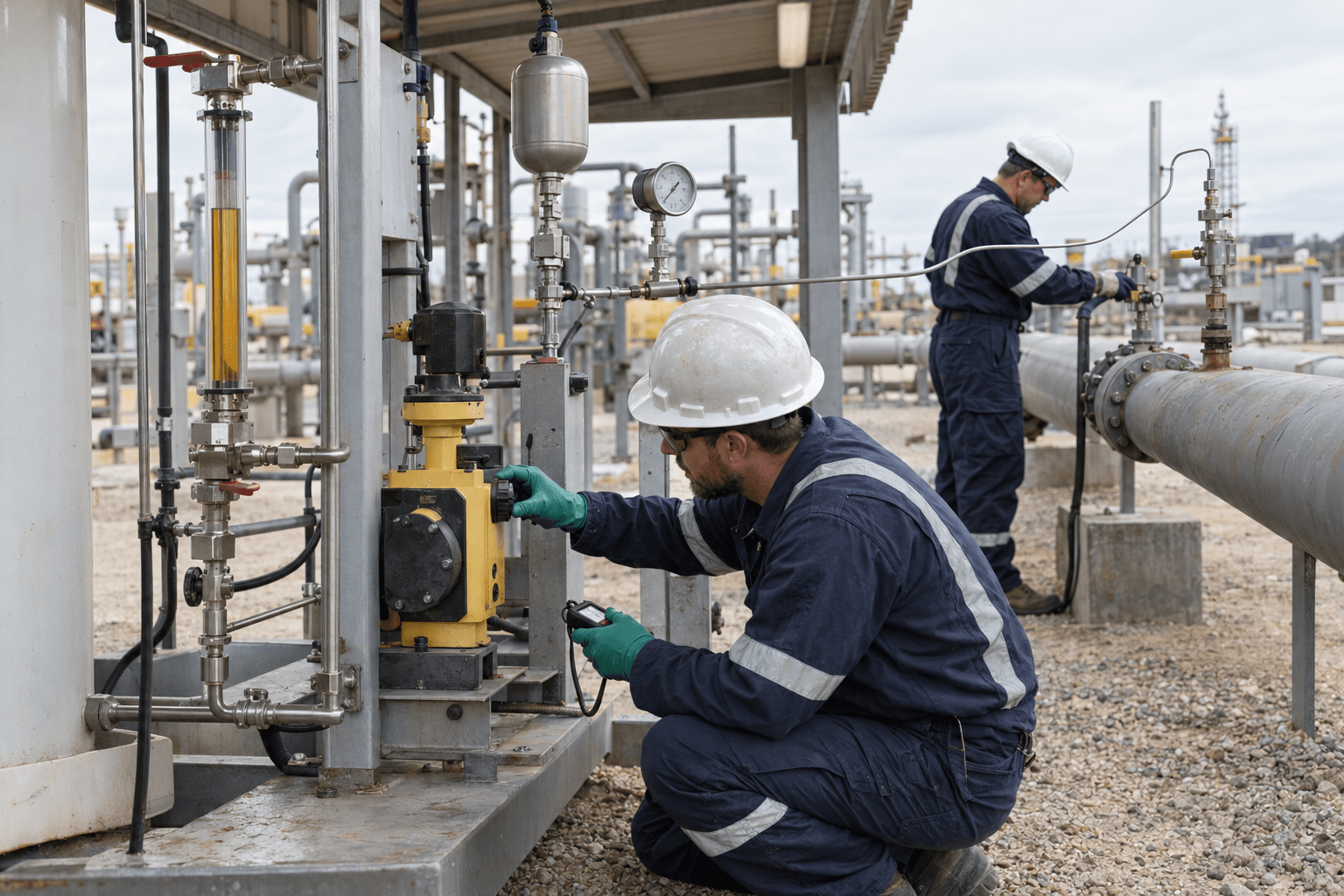
A corrosion inhibitor can perform very well in a laboratory test and still underperform in the field. That does not necessarily mean the chemistry is poor. In oil and gas production, inhibitor performance is a system property: the inhibitor must reach the corrosive aqueous phase, interact with the steel surface, establish and maintain sufficient protection, and remain effective as operating conditions change.
1. Good chemistry is only the starting point
Many oilfield corrosion inhibitors are surface-active organic formulations designed to reduce corrosion through adsorption and protective film formation on steel. Imidazoline-, amine-, amide- and quaternary-ammonium-based chemistries are common examples, but chemical family alone does not determine field performance. Adsorption, film persistence, solubility or dispersibility, phase behavior and compatibility all matter.
The practical question is therefore not simply “Is this a good inhibitor?” but “Is this inhibitor suitable for this fluid, metallurgy, flow regime, temperature, corrosive environment and treatment method?”
2. The corrosive phase must be represented correctly
Internal corrosion of carbon steel requires an electrolyte, so the aqueous phase is central to inhibitor evaluation. Brine composition, pH, dissolved salts, acid-gas loading and water fraction can materially change both baseline corrosivity and inhibitor behavior. CO₂ and H₂S environments also present different corrosion mechanisms and film conditions, so a screening test that does not represent the relevant environment can produce a misleading ranking.
Field water chemistry can also change over time. A product selected using one brine composition may face different salinity, water cut or produced-water chemistry later in field life.
3. Partitioning can determine how much inhibitor reaches the water
In multiphase oil/water systems, the injected dose is not necessarily the concentration available in the corrosive aqueous phase. Corrosion inhibitors can partition between hydrocarbon and water, and that partitioning may change with water cut and operating conditions. Published oilfield work has shown that inhibitor partitioning can vary dramatically as water cut changes.
This is one reason why equal injected ppm does not always mean equal protection. Two formulations dosed at the same total rate may deliver different effective concentrations to the phase contacting the steel.
4. Flow regime and wall shear can change protection
Static or low-shear laboratory tests are useful for screening, but pipelines and production equipment can experience stratified, slug, annular or other multiphase-flow regimes. These conditions affect wetting, mass transfer and the mechanical environment at the wall.
Higher wall shear does not automatically mean an inhibitor will fail, and a simple universal velocity limit is not scientifically defensible. Field and flow-loop studies show that inhibitor performance depends on the complete treatment system, including dose, film behavior, phase distribution and operating conditions. The important point is that the test method should expose the candidate to a hydrodynamic severity relevant to the application.
5. Surface condition matters
Laboratory coupons often begin with a controlled, reproducible surface. Field steel may not. Mill scale, corrosion products, pre-existing deposits, solids, hydrocarbon films and localized damage can change how readily an inhibitor reaches and adsorbs on the metal.
A formulation that rapidly protects a freshly prepared coupon may behave differently on a surface already covered by FeCO₃, FeS, scale or deposits. This is particularly important when evaluating treatment changes on an operating asset rather than chemical selection for a new system.
6. Temperature can affect both corrosion and inhibitor behavior
Temperature influences reaction kinetics, fluid properties, adsorption behavior, phase distribution and the stability of inhibitor films. High-temperature sweet-corrosion testing is especially demanding because a laboratory method must reproduce not only temperature but also CO₂ partial pressure, brine chemistry, pressure and hydrodynamics.
For this reason, a single room-temperature screening result should not be extrapolated to a high-temperature application without additional evidence.
7. Injection location and chemical delivery are part of performance
Even a technically suitable product cannot protect a surface it does not reach. Injection point, mixing, residence time, line configuration and the availability of a carrier phase can influence inhibitor transport and distribution.
Continuous injection and batch treatment also impose different requirements. Continuous treatment depends on reliable delivery and sufficient residual protection under operating conditions. Batch treatment additionally requires appropriate contact, film establishment and persistence between treatments.
8. Compatibility problems can undermine an otherwise effective inhibitor
A corrosion inhibitor is rarely the only production chemical in the system. Demulsifiers, scale inhibitors, hydrate inhibitors, biocides and other treatments may be present. Compatibility should therefore be assessed at realistic concentrations and in representative fluids.
The evaluation should consider more than corrosion rate alone. Depending on the application, emulsion tendency, water quality, foaming, precipitation, deposits or other process effects may be operationally important.
9. Average corrosion rate can hide localized corrosion
A low average corrosion rate does not automatically prove that localized attack is controlled. This is particularly important in sour service and other environments where pitting or localized corrosion may be a critical integrity threat.
Where the risk justifies it, inhibitor qualification should combine corrosion-rate measurements with post-test surface examination and an assessment of localized attack. Laboratory methods may include weight-loss coupons, electrochemical techniques such as LPR, autoclaves, rotating or high-shear methods and flow loops, selected according to the field question being investigated.
10. Laboratory screening should reproduce the decision—not merely generate a number
There is no single universally accepted laboratory test that can reproduce every field condition. A useful programme normally progresses from controlled screening toward increasingly application-specific evaluation. The purpose is not to create an artificial “best inhibitor” ranking; it is to reduce uncertainty before field application.
A practical qualification sequence
- Define the corrosion threat: metallurgy, CO₂/H₂S, brine chemistry, pH, temperature, pressure, water cut, solids and expected flow conditions.
- Define the treatment philosophy: continuous or batch treatment, injection location, expected transport and operational constraints.
- Screen candidates consistently: use controlled baseline and inhibited tests with representative fluids and clearly defined dosage.
- Challenge shortlisted products: evaluate relevant temperature, shear, phase ratio, partitioning, compatibility and surface conditions.
- Examine more than average corrosion rate: include surface condition and localized corrosion where relevant.
- Validate in the field: establish baseline data, monitor treatment delivery and compare corrosion-monitoring trends with operating changes.
Field monitoring closes the loop
Field validation is not simply a final pass/fail test. Corrosion coupons, LPR or ER probes, chemical residual measurements where appropriate, inspection data and operating parameters can be combined to determine whether the treatment is reaching the system and controlling the intended corrosion threat. No single monitoring technique should be interpreted in isolation.
For our application-focused corrosion-control capabilities, see Corrosion Inhibitors and Technical Expertise. For wet-gas, CO₂/H₂S, MEG and gas-throughput dosage calculations, see Corrosion Inhibitors in Gas Production Systems.
Frequently asked questions
Does a higher corrosion-inhibitor dose always improve protection?
No. Performance should be demonstrated over a relevant dosage range. Beyond the effective range, additional chemical may add cost without proportional benefit and can introduce compatibility or process concerns in some systems.
Can a static coupon test predict field performance?
It can provide useful screening evidence, but it does not reproduce every field variable. Where hydrodynamics, multiphase partitioning, high temperature or surface condition are important, additional application-specific testing may be required.
Why can two inhibitors at the same injected ppm perform differently?
The total injected concentration is not necessarily the concentration available at the corrosive surface. Formulation, partitioning, transport, water cut, adsorption and operating conditions can all influence effective protection.
What should be monitored during a field trial?
The monitoring plan should match the corrosion threat and asset. Depending on the system, useful evidence can include coupons, LPR or ER probes, inspection data, operating conditions, treatment delivery and appropriate chemical residual measurements.
Conclusion
A good corrosion inhibitor can fail in the field when the application prevents the chemistry from doing its job. The most common gaps are not explained by one universal mechanism: they can involve phase partitioning, water chemistry, temperature, wall shear, surface condition, chemical delivery, compatibility or a laboratory method that did not represent the field sufficiently well.
Reliable inhibitor selection therefore requires a chain of evidence: representative laboratory testing → application-specific qualification → controlled field validation → ongoing monitoring. The objective is not simply to identify a molecule that inhibits corrosion, but to establish a treatment programme that remains effective under the operating envelope of the asset.
Technical references
- AMPP/NACE SP21469-2021, Corrosion Inhibition Selection and Management for Oil and Gas Production.
- Kapusta, S.D., “Corrosion Inhibitor Testing and Selection for E&P: a User’s Perspective,” CORROSION 1999.
- Joosten, M.W. et al., “Partitioning of Corrosion Inhibitor in Relationship to Oil Field Applications and Laboratory Testing,” CORROSION 2000.
- Askari, M. et al., “Film former corrosion inhibitors for oil and gas pipelines – A technical review,” Journal of Natural Gas Science and Engineering, 2018.
- Obot, I.B. et al., “A review study on the challenges and progress of corrosion inhibitor testing under extreme conditions in the oil and gas industries,” Geoenergy Science and Engineering, 2023.