
How Scale Inhibitors Work at the Molecular Level
Scale Control · Technical Insight
Technical Review | Oilfield Scale Control
Mineral scale is a persistent flow-assurance challenge in oil and gas production. Effective scale control starts before a visible deposit forms, but the molecular mechanisms of threshold inhibition are more nuanced than many simplified diagrams suggest.
1. From Supersaturation to Deposition
Scale formation begins when the aqueous phase becomes supersaturated with respect to a mineral phase. Produced and injection waters may contain Ca²⁺, Ba²⁺, Sr²⁺, bicarbonate, carbonate and sulfate species that remain dissolved under one set of conditions but become supersaturated after changes in pressure, temperature, pH, CO₂ behavior or water mixing.
For calcium carbonate, the precipitation step is commonly summarized as Ca²⁺ + CO₃²⁻ → CaCO₃(s). This is a useful shorthand, but actual carbonate speciation and precipitation kinetics depend on the complete aqueous chemistry.
Nucleation→
Crystal growth→
Agglomeration / deposition
Conceptual framework only. It does not imply that every inhibitor acts directly at every stage.
Supersaturation provides the thermodynamic driving force for precipitation; it does not by itself determine how rapidly scale appears. Nucleation, crystal growth, surfaces, suspended matter and trace impurities can strongly affect kinetics.
2. Threshold Inhibition: What Can Be Said with Confidence?
Commercial phosphonates and polycarboxylates are commonly used at low, sub-stoichiometric dosage. Consequently, their performance cannot generally be explained by stoichiometrically sequestering all scale-forming Ca²⁺, Ba²⁺ or Sr²⁺ ions. Complexation can occur and may contribute to solution chemistry, but it should not automatically be equated with the threshold effect.
Traditional explanations include interactions with nuclei or growing mineral surfaces, delayed nucleation, crystal-growth modification and dispersion. A 2026 critical review by Popov and co-workers challenges the universal application of several of these explanations and emphasizes direct inhibitor visualization, full chemical speciation and the possible importance of nano/micro-impurities. By contrast, a separate 2026 review of phosphorus-based polymeric inhibitors describes multi-effect behavior including ion complexation, adsorption, growth modification and dispersion for specific polymer classes. These views are not necessarily mutually exclusive; they show why mechanism should be stated for a defined chemistry and test system rather than generalized to all scale inhibitors.
| Family | Representative chemistry | Relevant functionality |
|---|---|---|
| Bisphosphonate | HEDP | Two phosphonate groups + hydroxyl |
| Aminophosphonate | ATMP | Three methylenephosphonic-acid groups on tertiary N |
| Phosphonocarboxylate | PBTCA / PBTC | Phosphonate + carboxylate functionality |
| Polycarboxylate | Polyacrylate (PAA) | Repeating carboxylate-bearing polymer backbone |
This table identifies chemistry classes; it is not a performance ranking and does not assign a universal molecular mechanism.
3. Crystal Morphology Is an Observation — Not Mechanistic Proof
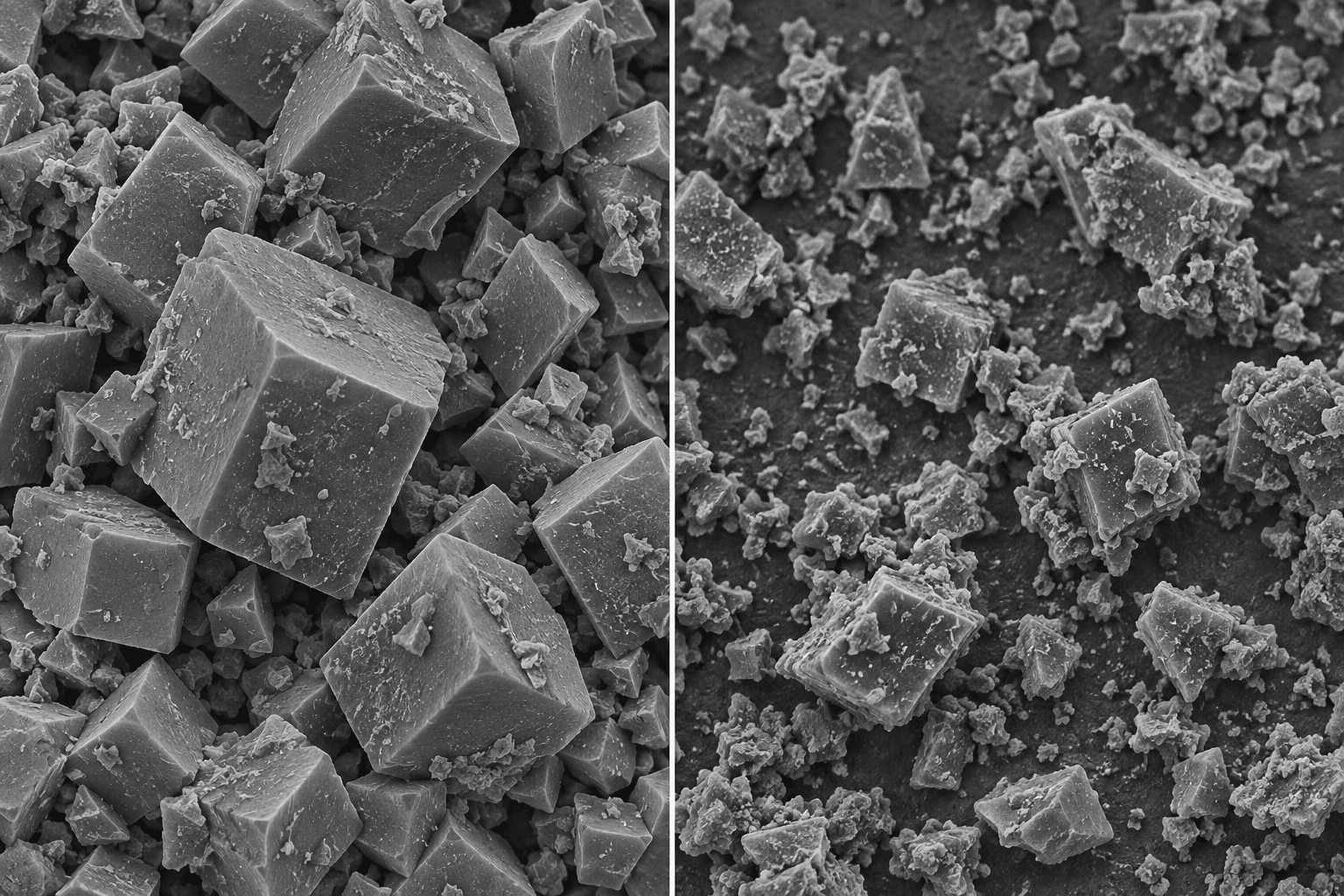
Scale produced in the presence of an inhibitor can differ in particle size, crystal habit or morphology from an untreated blank. Such observations can be valuable, but they do not uniquely prove how inhibition occurred. A distorted crystal does not, by itself, demonstrate that inhibitor molecules blocked a particular terrace, step or kink site.
The same caution applies to dispersion. Some polymeric formulations can reduce particle agglomeration or surface attachment, but dispersion should not be presented as the universal primary mechanism of every phosphonate or polycarboxylate inhibitor.
Illustrative only — not experimental data. Actual induction behavior depends on scale chemistry, supersaturation, temperature, inhibitor concentration and test method.
4. Scale Type Changes the Problem
Calcium carbonate is strongly influenced by carbonate speciation, CO₂ behavior and pH. Barium sulfate and strontium sulfate present different precipitation chemistry and can become critical when sulfate-bearing injection water mixes with formation water rich in Ba²⁺ or Sr²⁺. Calcium sulfate introduces another solubility and kinetic regime.
An inhibitor that performs well against CaCO₃ should not be assumed to provide equivalent control of BaSO₄, SrSO₄ or CaSO₄. A technically meaningful performance claim should specify the target mineral, brine composition, temperature, pH or pressure window, residence time, dosage and test method.
5. Representative Scale-Inhibitor Chemistries
Low-molecular-weight phosphonates
Widely used examples include ATMP, HEDP, DTPMP and PBTCA/PBTC. Their useful low-dose performance is well established, but calcium tolerance, salinity, temperature and precipitation/compatibility behavior must be considered for the intended application.
Polycarboxylates
Polyacrylates and related polymers are common scale-control chemistries. Molecular weight, architecture, functional-group density, brine composition and operating conditions influence performance.
Phosphorus-containing polymers
Recent polymer designs combine phosphorus-containing groups with tunable polymer architectures. A 2026 review describes applications in oilfield squeeze treatments and continuous injection, while also emphasizing remaining uncertainties in structure–performance relationships and field translation.
6. Laboratory Evaluation Must Reproduce the Field Problem
Static inhibition testing is useful for comparative screening and minimum-effective-concentration work. Dynamic scale-loop testing adds flow, residence time and pressure-drop response. Compatibility testing is important in concentrated brines and multi-chemical programs. Thermal stability and squeeze retention/return behavior become particularly important in high-temperature and downhole applications.
Microscopy, XRD and related solids characterization can add valuable evidence, but morphology should be interpreted alongside aqueous chemistry and, where possible, direct information on inhibitor location/speciation.
Scale prediction→
Static screening→
Dynamic testing→
Field validation
7. Why a Laboratory Winner Can Fail in the Field
Field ranking can diverge from laboratory ranking when water composition, pH, temperature, pressure, CO₂ behavior, residence time, hydrodynamics, suspended solids, iron, mixing or other production chemicals are not represented correctly. Continuous injection also depends on delivery of an effective concentration to the critical location, while squeeze treatments require retention and return-concentration behavior to be considered.
8. Practical Scale-Inhibitor Selection Checklist
- Identify the expected mineral scale and the likely deposition location.
- Use representative produced-water and/or injection-water chemistry.
- Reproduce the relevant temperature, pH, pressure and residence-time envelope.
- Determine minimum effective concentration under representative conditions.
- Check compatibility with brine and other production chemicals.
- Use dynamic testing where hydrodynamics materially affect the scale risk.
- Validate laboratory ranking against field response whenever practical.
9. Frequently Asked Questions About Scale Inhibitors
Do scale inhibitors dissolve existing scale?
Generally, scale inhibitors are intended to control precipitation and deposition rather than remove an established mineral deposit. Existing scale may require a separate mechanical or chemical remediation selected for the specific mineral.
Is more scale inhibitor always better?
No. Treatment should be optimized around the effective concentration and operating envelope. Excess dosage adds cost and can introduce compatibility or precipitation concerns in some systems.
Can one inhibitor control every oilfield scale?
No universal assumption should be made. Performance against CaCO₃, BaSO₄, SrSO₄ or CaSO₄ should be demonstrated under representative brine and operating conditions.
10. Scale Inhibitor Selection: Technical Conclusion
The strongest scientific position is not to claim one universal molecular mechanism. Scale inhibition reflects interactions among thermodynamics, precipitation kinetics, interfaces, trace solids, inhibitor speciation, water composition and operating conditions. Chemical selection should therefore combine water analysis, scale prediction, laboratory testing and field optimization.
Scientific References
- Popov K., Oshchepkov A., Oshchepkov M., Ryabova A., Trukhina M., Tkachenko S. Some misconceptions about scale inhibition mechanisms: A review. Desalination 631 (2026) 120221. DOI: 10.1016/j.desal.2026.120221.
- Chen S., Hou J., Da C., Chen T. Phosphorus-based polymeric scale inhibitors for energy and water industries: Synthesis, inhibition mechanism, and field deployment. Desalination 637 (2026) 120456. DOI: 10.1016/j.desal.2026.120456.
Related Oilfield Scale-Control Resources
Explore our Scale Inhibitors page, our detailed Scale Inhibitor Base Chemistries review, and broader Oilfield Chemicals capabilities.
This article is an educational technical review. Product selection and dosage should be validated against the actual water chemistry and operating conditions of the target system.