
Biocide Chemistries in Oil & Gas: Types, Mechanisms, Advantages and Limitations
Microbial Control · Chemistry Review
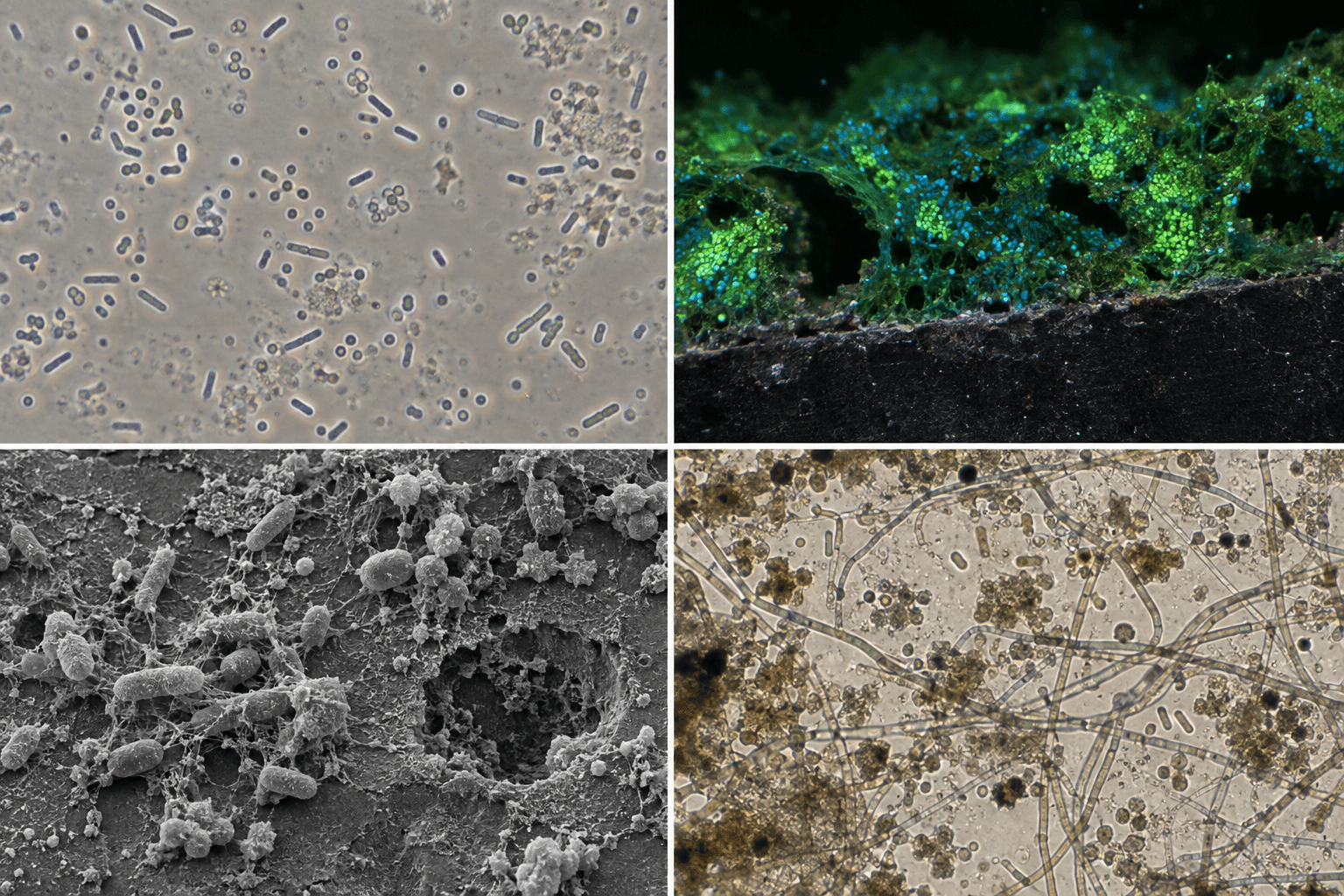
Biocide selection in oil and gas is a system-design problem, not a search for one universally strongest active. Produced water, seawater injection, hydrotest water, tanks and pipelines can contain different microbial communities, biofilms, reducing agents, hydrocarbons, solids and corrosion products. These variables affect both microbiological risk and the chemistry available to control it.
1. Why microorganisms matter
Microbial activity can contribute to souring, biomass accumulation, plugging, degradation of process fluids and microbiologically influenced corrosion (MIC). Sulfate-reducing microorganisms, methanogens, acid-producing organisms and other biofilm-forming communities may be relevant. MIC should not be diagnosed from the presence of one microbial group alone; assessment should combine microbiology with corrosion morphology, deposits, chemistry and operating history.
2. Oxidizing versus non-oxidizing biocides
Oxidizing biocides damage cells through oxidative chemistry. Examples include chlorine/hypochlorite, chlorine dioxide and bromine-based oxidants. Non-oxidizing biocides act through more specific chemical interactions with proteins, membranes, enzymes or metabolism. Glutaraldehyde, THPS, isothiazolinones, DBNPA, QACs and bronopol are operationally grouped here, although their mechanisms differ substantially.
3. Glutaraldehyde
Glutaraldehyde is a well-known non-oxidizing oilfield biocide. Its antimicrobial activity is associated with reaction with cellular functional groups and modification/crosslinking of biomolecules. Oilfield literature documents use against planktonic and sessile organisms.
Strengths: broad activity and extensive oilfield history. Limitations: performance depends on concentration, contact time, temperature, pH and chemical demand; biofilm control can require different conditions from planktonic testing; occupational hazards require appropriate controls.
4. THPS
Tetrakis(hydroxymethyl)phosphonium sulfate (THPS) is a phosphonium-based non-oxidizing biocide with extensive use in industrial and oilfield water systems. Its chemistry is distinct from aldehydes and QAC membrane-active surfactants.
Strengths: established oilfield water use and water compatibility. Limitations: no universal dose can be generalized; chemical demand, biofilm mass, temperature and contact time can materially change efficacy, and environmental/discharge requirements are jurisdiction-specific.
5. Isothiazolinones
Isothiazolinones are electrophilic non-oxidizing antimicrobial compounds used in industrial water, preservation and selected oilfield formulations. The family includes CMIT (5-chloro-2-methyl-4-isothiazolin-3-one), MIT (2-methyl-4-isothiazolin-3-one), BIT (1,2-benzisothiazolin-3-one) and more hydrophobic derivatives such as OIT (2-octyl-2H-isothiazol-3-one). They are not interchangeable; substitution changes hydrophobicity, stability, antimicrobial spectrum and regulatory profile.
Mechanism: the isothiazolinone ring reacts with cellular nucleophiles, particularly thiol-containing biomolecules, causing rapid inhibition of key metabolic enzymes followed by broader cellular damage. It is therefore inaccurate to describe this family simply as membrane-disrupting surfactants.
Potential strengths: high potency and useful activity at relatively low concentrations in suitable systems. Potential limitations: reducing and nucleophilic species can consume or deactivate the active; pH, temperature and formulation affect stability; some members are strong sensitizers; permitted uses and concentrations are jurisdiction- and application-specific. For produced-water service, efficacy and active lifetime should be verified in representative field water and at realistic contact time.
6. DBNPA
2,2-Dibromo-3-nitrilopropionamide (DBNPA) is a fast-acting non-oxidizing biocide used in industrial water and selected oilfield systems. Its antimicrobial action includes reaction with essential cellular components. A major characteristic is relatively rapid degradation under many aqueous conditions.
Strength: rapid kill and limited persistence where desired. Limitation: stability is sensitive to pH, temperature and reactive species, so actual process lifetime matters.
7. Quaternary ammonium compounds
QACs are cationic surfactants whose antimicrobial action is strongly associated with adsorption to and disruption of microbial membranes. Hydrophobic groups interact with membrane structures while the cationic head promotes interaction with negatively charged cell surfaces.
QACs can also adsorb onto solids, sludge and negatively charged surfaces, reducing freely available active concentration. Organic load and biofilm architecture therefore influence performance. Different QAC structures should not be assumed to have identical oilfield efficacy.
8. Bronopol
Bronopol (2-bromo-2-nitropropane-1,3-diol) is a non-oxidizing antimicrobial used in industrial preservation and water-related applications. Its chemistry can affect cellular thiol systems and involves reactive decomposition pathways. Effectiveness and decomposition depend on pH, temperature and water chemistry; regulatory status must be checked for the actual application.
9. Chlorine and hypochlorite
Chlorination is widely used in water systems. In water, chlorine forms hypochlorous acid/hypochlorite, with speciation strongly dependent on pH. Oxidant demand from organics, sulfide, ferrous iron and other reduced species can consume active chlorine rapidly. Corrosion, materials compatibility and downstream effects must be considered.
10. Chlorine dioxide
Chlorine dioxide is a strong oxidizing biocide used in industrial water treatment. Its chemistry differs from free chlorine and it can provide useful control over a broad pH range in appropriate applications. It is generated and handled under controlled procedures because it is a reactive oxidant.
11. Bromine-based oxidants
Bromine chemistry is used in industrial water treatment and can be advantageous in some higher-pH waters. As with chlorine, efficacy depends on active residual, water chemistry and oxidant demand. Metallurgy, discharge constraints and interactions must be assessed.
12. Biofilm changes the problem
Planktonic organisms are easier to contact than cells embedded in mature biofilm. Extracellular polymeric substances, corrosion products, mineral deposits and solids can consume or slow transport of biocide. A strong planktonic log reduction does not guarantee equivalent control of established sessile biomass.
13. MIC is more than SRB kill
Sulfate-reducing microorganisms are important in many oilfield systems, but MIC is not synonymous with SRB. Methanogens, acid producers and mixed consortia can participate. Molecular detection identifies organisms but does not by itself prove corrosion causation.
14. Comparison of major families
| Biocide | Type | General action | Strength | Limitation |
|---|---|---|---|---|
| Glutaraldehyde | Non-oxidizing | Reaction/crosslinking with biomolecules | Broad oilfield history | Contact time, demand, biofilm penetration |
| THPS | Non-oxidizing phosphonium | Multisite antimicrobial chemistry | Established oilfield use | System-specific demand/exposure |
| CMIT/MIT | Isothiazolinone | Reaction with thiol-containing biomolecules | High potency | Stability, sensitization, regulation |
| DBNPA | Non-oxidizing | Fast reaction with cellular components | Rapid kill | Short persistence |
| QAC | Cationic surfactant | Membrane interaction/disruption | Broad formulation options | Adsorption to solids/organic demand |
| Bronopol | Non-oxidizing | Reactive antimicrobial chemistry | Selected water systems | Stability/regulatory constraints |
| Chlorine | Oxidizing | Oxidative damage | Fast, measurable residual | Oxidant demand/material effects |
| Chlorine dioxide | Oxidizing | Oxidative damage | Strong water-treatment active | Generation/handling complexity |
15. Produced water and injection water
Produced and injection waters can contain high salinity, hydrocarbons, solids, sulfide and reducing species. These factors can change active lifetime dramatically, so selection should use actual or representative field water whenever possible. Seawater injection additionally requires consideration of incoming microbial populations, nutrients, oxygen control and reservoir souring risk.
16. Hydrotest water and preservation
Hydrotest and lay-up systems can remain stagnant for extended periods. Treatment design should consider fill-water quality, storage time, temperature, metallurgy and disposal route.
17. Continuous versus batch treatment
Some systems require continuous residual control, while others use periodic slug treatment. The strategy depends on microbial growth, biofilm burden, residence time and active persistence. Fast-kill chemistry is not automatically preferable if a long residual is required.
18. Should biocides be rotated?
Rotation is often proposed to manage reduced susceptibility, but routine rotation is not a universal rule. Apparent loss of performance may reflect increased biofilm, poor delivery, higher chemical demand, changed water chemistry or inadequate contact time rather than inherited resistance. Changing or combining actives should be supported by system-specific efficacy data.
19. How to evaluate a biocide
- Characterize water chemistry, pH, temperature, salinity, sulfide and solids.
- Define whether the problem is planktonic, sessile or both.
- Screen at realistic concentration and contact time.
- Use an appropriate validated neutralizer/quench during microbiological sampling so residual biocide does not continue killing after sampling.
- Evaluate biofilm efficacy when surface-associated growth is relevant.
- Check compatibility with corrosion inhibitor, scale inhibitor, demulsifier and other chemicals.
- Consider materials compatibility, discharge limits and environmental fate.
- Validate with field microbiological and integrity monitoring.
20. Monitoring methods
Culture methods detect only organisms able to grow under the chosen laboratory conditions. ATP provides rapid information related to biological activity, while qPCR and sequencing can detect targeted or broader microbial populations. Trends are most useful when microbiology is interpreted alongside operating conditions, chemical residuals, deposits and corrosion evidence.
Frequently asked questions
Is THPS always better than glutaraldehyde?
No. Relative performance depends on water chemistry, organisms, biofilm, concentration, temperature and contact time.
Is CMIT/MIT suitable for produced water?
It can be effective in suitable systems, but stability must be verified in the actual water. Reducing/nucleophilic species, temperature and pH can shorten active lifetime.
Does killing planktonic SRB prove MIC is controlled?
No. Sessile biofilm organisms can behave differently, and MIC diagnosis requires more evidence than planktonic counts or SRB detection alone.
Is a fast-kill biocide always preferable?
No. Kill speed must be matched to contact time, delivery, biofilm burden and required residual.
Conclusion
Oilfield biocide selection requires matching chemistry to microbial ecology and process environment. Glutaraldehyde, THPS, isothiazolinones, DBNPA, QACs, bronopol and oxidizing halogen systems offer different combinations of kill kinetics, persistence, phase behavior and compatibility.
No one family is universally preferred. The best programme is not the one with the most aggressive bottle-test kill; it is the one that reaches target organisms, provides the required kill kinetics and persistence, controls sessile risk where necessary, remains process-compatible and satisfies integrity, safety and environmental requirements.
Technical references
- Videla, H. A.; Herrera, L. K. Microbiologically influenced corrosion: looking to the future. International Microbiology 2005, 8, 169–180.
- Jia, R.; Unsal, T.; Xu, D.; Lekbach, Y.; Gu, T. Microbiologically influenced corrosion and current mitigation strategies: A state of the art review. International Biodeterioration & Biodegradation 2019, 137, 42–58.
- Williams, T. M. The mechanism of action of isothiazolone biocides. PowerPlant Chemistry 2007, 9, 14–22.
- Denyer, S. P. Mechanisms of action of antibacterial biocides. International Biodeterioration & Biodegradation 1995, 36, 227–245.
Related Horizons Apex resources: Biocides, Technical Expertise, Corrosion Inhibitor Chemistries, and Oilfield Corrosion Inhibitor Testing.