
Antifoam and Defoamer Chemistries in Oil & Gas: Types, Mechanisms, Advantages and Limitations
Foam Control · Chemistry Review
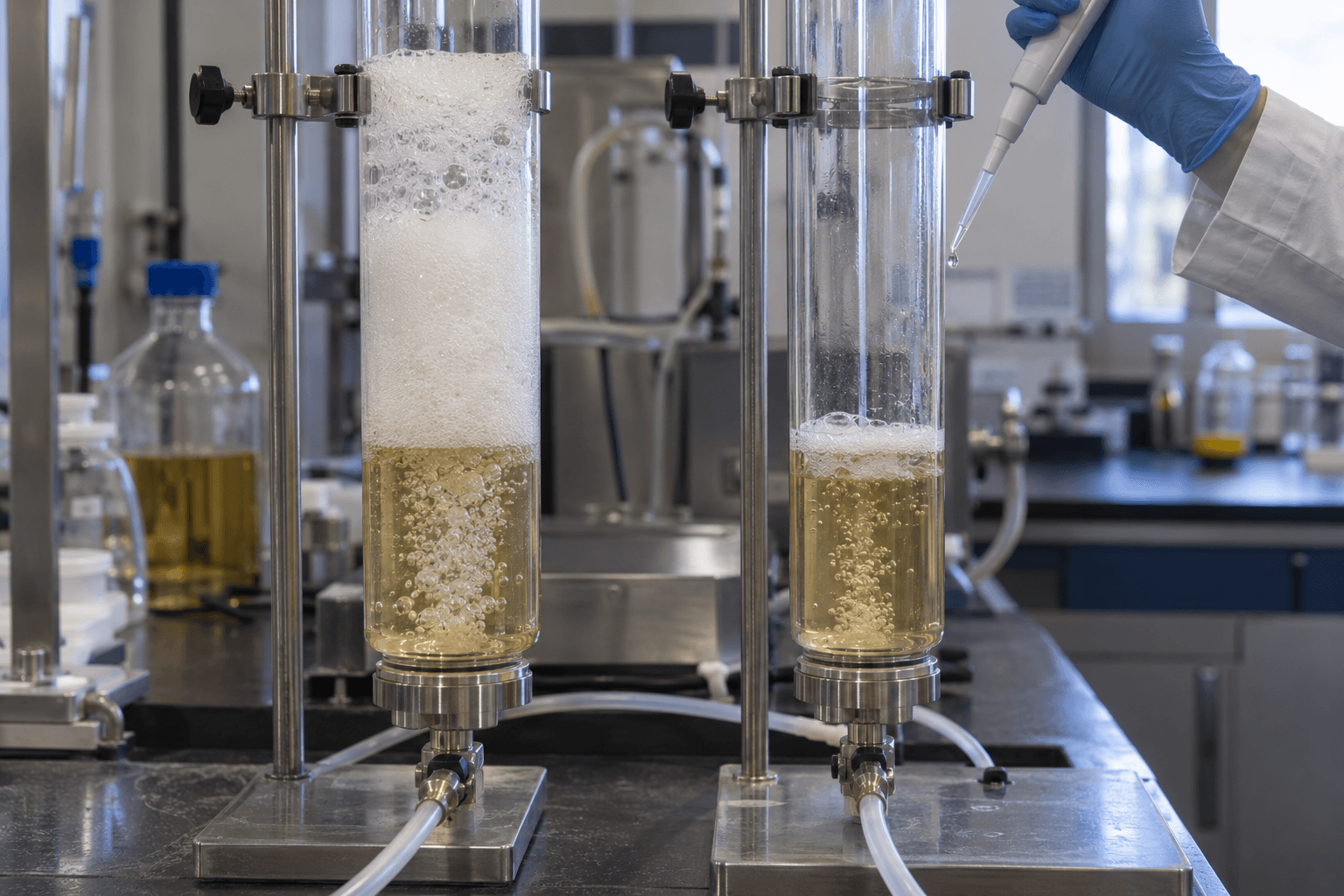
Industrial foam control is not a one-chemistry problem. The antifoam that works in a crude-oil separator may perform poorly in an aqueous amine unit, and a highly effective silicone product can be unacceptable where downstream silicon contamination is critical. Selection starts with the foaming medium, foam stabilizers and process constraints.
1. Antifoam versus defoamer
The terms often overlap in industry. Functionally, antifoam emphasizes prevention or reduction of foam formation, while defoamer emphasizes rapid destruction of existing foam. One formulation can perform both functions, so performance should be defined by the test rather than the product name.
2. Why foam chemistry matters
Foam consists of gas bubbles separated by liquid films. Surfactants, polar crude components, polymers, fine solids and contaminants can slow film drainage and stabilize interfaces. Effective foam-control agents must enter or destabilize these films and promote rupture. Mechanistic descriptions include entry, spreading, bridging and film rupture; the dominant pathway depends on chemistry and whether the continuous phase is aqueous or hydrocarbon-based.
3. PDMS silicone oils
Polydimethylsiloxane (PDMS) is one of the most important antifoam chemistries in oil and gas processing. Peer-reviewed work on depressurization-generated crude-oil foams identifies PDMS oils as the most common chemical antifoams in that application and fluorosilicone oils as important for severe cases. This should not be generalized to every aqueous or gas-treatment process.
PDMS combines low surface energy with controlled incompatibility with many foaming media. In oil-phase applications, molecular weight and viscosity matter because excessive solubilization of silicone in hydrocarbons can reduce effectiveness. Crude composition therefore changes the optimum grade.
Advantages: strong low-dose knockdown in many hydrocarbon systems, thermal robustness and extensive field history. Limitations: performance can fall when silicone becomes too soluble; high-viscosity grades are harder to disperse; silicon carryover can be undesirable in downstream refining.
4. Silica-filled silicone antifoams
Silicone compounds used for aqueous foam control are often formulated with hydrophobic silica, but the role of silica is medium- and formulation-dependent. Hydrophobic particles can participate in film rupture when properly wetted and delivered with the silicone phase. By contrast, studies of nonaqueous oil foams also show that silica nanoparticles can stabilize foam depending on particle hydrophobicity and concentration. Therefore, silica should not be described as intrinsically antifoaming; particle wetting, concentration and formulation determine its effect.
5. Silicone emulsions
Silicone compounds can be delivered as aqueous emulsions to facilitate dosing into water-based systems. The emulsion is a delivery form rather than a completely separate active mechanism. Droplet size, emulsion stability, storage, dilution and release of the active silicone into the process all affect performance.
6. Organomodified silicones
Replacing some methyl groups on a siloxane backbone with organic or polyether-containing groups changes compatibility with the process liquid. Oilfield foam-control literature identifies organomodified silicones as a principal family for oil-based systems. Their strength is tunability; their limitation is that excessive compatibility can remove the controlled incompatibility needed for antifoam action.
7. Fluorosilicones
Fluorosilicones contain fluorinated organic substituents on a siloxane framework. In crude-oil foam control they are particularly important for difficult hydrocarbon systems in which conventional PDMS becomes too soluble. Published crude-oil studies identify them as highly effective for severe cases.
Advantages: strong difficult-oil foam control and potentially low effective dosage. Limitations: higher cost and the need to evaluate fluorinated chemistry against current environmental and discharge requirements for the intended market.
8. Polyalkylene glycols and EO/PO polyethers
Polyalkylene glycols, including EO/PO-based polyethers, are important organic antifoams particularly in aqueous and gas-treatment applications. Molecular weight, EO/PO composition and architecture control water affinity, cloud behavior and interfacial properties. Controlled limited solubility can support antifoam action, while excessive solubility may reduce it.
Peer-reviewed reviews of acid-gas sweetening identify polyether glycol antifoams alongside silicone, alcohol and blended products as major candidate families.
9. Alcohol-based antifoams
Higher alcohols and formulated alcohol systems are used as organic foam-control agents in selected aqueous processes. They offer silicone-free operation but their effectiveness, persistence and temperature window are application-specific. Alcohol-based products are among the classes evaluated for gas-sweetening service.
10. Hydrocarbon-oil, wax and fatty-material systems
Mineral oils, hydrocarbon carriers, waxes, fatty alcohols and related hydrophobic materials are common components of industrial defoamers. They can serve as active liquid phases, spreading components or carriers for hydrophobic solids. They require evaluation for deposits, process compatibility and downstream product quality.
11. Polyacrylate and other silicone-free polymers
Silicone-free polymeric foam suppressors are an active area of petroleum research. A 2021 Energy & Fuels study evaluated alkyl acrylate homopolymers in heavy crude and found that selected longer-alkyl polyacrylates could outperform the tested commercial silicone at suitable molecular weight. This is system-specific evidence, not a universal ranking.
12. Blended antifoams
Practical products can combine active liquid, hydrophobic particles, carriers, emulsifiers or secondary organic antifoams. In gas sweetening, a peer-reviewed review concluded that blended products can satisfy a broad range of selection criteria, while the optimum blend remains process-specific.
13. Crude-oil separators
Pressure reduction in separators releases dissolved gas and can generate large foam volumes, reducing vessel capacity and disrupting level control. For oil-based crude foams, PDMS, organomodified silicones and fluorosilicones are established families. A 2017 Energy & Fuels depressurization study confirmed that additive ranking depends on crude composition.
14. Acid-gas sweetening and amine units
Foaming in alkanolamine absorbers can reduce mass-transfer efficiency, increase amine losses and contribute to flooding. Hydrocarbons, degradation products, corrosion products and suspended solids can contribute to foam stability.
Selection should consider solubility, dispersibility, surface tension, viscosity, defoaming rate, thermal stability, persistence, chemical inertness and process hazards. Scientific reviews specifically compare silicone, polyether glycol, alcohol and blended antifoams for this service.
Antifoam should not be used to mask an underlying contamination problem. Filtration, hydrocarbon ingress, amine degradation and operating conditions may require correction alongside chemical foam control.
15. Produced water and water-based systems
Produced-water and other water-continuous systems often favor chemistries designed for aqueous media. Silica-filled PDMS and polyalkylene-glycol systems are common starting points, but oil carryover, salinity, solids and treatment chemicals can materially change performance.
16. Refining and downstream silicon risk
Silicone antifoams are highly effective, but silicon-containing carryover can be problematic in downstream refining. Peer-reviewed work developing silicone-free crude-oil defoamers specifically cites catalyst poisoning in petroleum refining as a motivation for alternative chemistry. This does not mean silicone must always be avoided; the actual risk depends on dosage, carryover, downstream destination and the silicon tolerance of the refining process.
17. Comparison of major chemistries
| Chemistry | Typical strength | Application fit | Important limitation |
|---|---|---|---|
| PDMS | Strong low-dose oil-phase foam control | Crude separators, hydrocarbon systems | Solubility in some light oils; silicon concerns |
| Silica-filled PDMS | Strong aqueous foam-film rupture | Water-based processes | Solid dispersion and compatibility |
| Organomodified silicone | Tunable compatibility | Oil-based and specialty systems | Over-compatibility can reduce activity |
| Fluorosilicone | Strong difficult-oil foam control | Severe crude/condensate foaming | Cost and environmental assessment |
| EO/PO polyether / PAG | Silicone-free, tunable aqueous behavior | Gas sweetening, aqueous systems | Strong dependence on solubility/cloud behavior |
| Alcohol-based | Silicone-free foam control | Selected aqueous/gas-treatment systems | Persistence and volatility can limit use |
| Hydrocarbon/wax/fatty systems | Formulation flexibility | General industrial systems | Deposits and downstream effects |
| Polyacrylate/polymeric | Potential silicone-free crude-oil performance | Specialty oil-phase applications | Architecture and MW must be optimized |
18. What should be measured?
- Foamability: foam generated under defined conditions.
- Knockdown: speed of collapse of existing foam.
- Persistence: control during continued gas generation.
- Re-foaming: whether foam returns after initial collapse.
- Dosage response: optimum range rather than assuming more is better.
- Side effects: emulsion, water quality, fouling, deposits, catalyst contamination and product-quality effects.
19. Why a shake test can mislead
A simple shake test is useful for screening but may not reproduce the foam-generation mechanism in a separator or absorber. Crude-oil research has used depressurization tests to mimic gas liberation during separation, while aqueous-process tests may use controlled gas sparging or recirculation. The test should reproduce the actual foam-generation mechanism as closely as practical.
20. Practical selection workflow
- Identify the continuous phase: oil, water, amine or other liquid.
- Identify foam stabilizers: surfactants, crude polar species, solids, degradation products or contamination.
- Define temperature, pressure, gas rate and residence time.
- Identify downstream restrictions, especially silicon tolerance.
- Screen multiple chemistry families at controlled dose.
- Measure initial knockdown and persistent/re-foam behavior.
- Check process compatibility and side effects.
- Validate under representative operating conditions.
Frequently asked questions
Is silicone always the strongest antifoam?
No. PDMS is highly effective in many oil-phase systems, but performance depends on crude composition and solubility. Fluorosilicones can outperform it in difficult hydrocarbons, while properly designed silicone-free polymers can also perform strongly in specific systems.
Is a defoamer different from an antifoam?
The terms overlap. Antifoam emphasizes prevention or reduction of foam formation, while defoamer emphasizes collapse of existing foam. Many commercial products perform both functions.
Can too much antifoam cause problems?
Yes. Overdosing can increase cost and may cause compatibility, separation, deposit, downstream or product-quality problems depending on chemistry and process.
Should the same antifoam be used in crude oil and an amine unit?
Not by default. Oil-based and water/amine-based foams have different continuous phases and stabilizing chemistry, so optimum antifoam families and delivery requirements can differ substantially.
Conclusion
Antifoam selection in oil and gas is a problem of controlled incompatibility. PDMS, silica-filled silicones, organomodified silicones, fluorosilicones, EO/PO polyethers, alcohols, hydrocarbon/wax systems and silicone-free polymers each occupy different performance windows.
The correct chemistry is the one that reaches the foam film, destabilizes it rapidly and persistently, remains compatible with the process and does not create a larger downstream problem. Representative testing and process-specific selection are therefore more reliable than choosing by product family alone.
Technical references
- Blázquez, C. et al. Crude Oil Foams: Testing and Ranking of Antifoams with the Depressurization Test. Energy & Fuels 2017, 31, 1285–1294. DOI: 10.1021/acs.energyfuels.6b02567.
- Koczo, K. et al. Foam Control. Oil and Gas Chemistry Management Series, 2023, pp. 153–226. DOI: 10.1016/B978-0-12-823891-2.00002-8.
- Selection Criteria for Antifoams Used in the Acid Gas Sweetening Process. Industrial & Engineering Chemistry Research 2021. DOI: 10.1021/acs.iecr.1c02269.
- Effect of the Chemical Structure of Alkyl Acrylates on Their Defoaming Activity in Crude Oil. Energy & Fuels 2021. DOI: 10.1021/acs.energyfuels.1c00181.
- Foaming of Oils: Effect of Poly(dimethylsiloxanes) and Silica Nanoparticles. ACS Omega 2019. DOI: 10.1021/acsomega.9b00347.
Related Horizons Apex resources: Antifoams, Technical Expertise, Crude Oil Dehydration and Desalting Systems, and Crude Oil Types and Petroleum Emulsions.